



Why a Digital Notarization Secure Platform Matters for High-Volume Transactions
Disclaimer: This blog post is for informational purposes only and does not constitute legal advice. Please consult an attorney for guidance on specific laws regarding Remote Online Notarization (RON), digital signatures, and related legal matters. As laws concerning RON and notarization are subject to frequent changes, it is advisable to verify current regulations with your local government.
Organizations that handle large volumes of contracts or regulated documents often face a familiar problem. Traditional notarization can slow transactions, create scheduling challenges, and introduce unnecessary friction into digital workflows.
A digital notarization secure platform offers another option. These platforms allow signers and notaries to complete legally recognized notarial acts remotely using secure audio-visual technology, identity verification tools, and encrypted document technology.
For enterprise teams managing high volumes of contracts, real estate transactions, or regulated documents, a digital notarization secure platform can address several operational challenges at once:
- Scalability: Platforms that support on-demand notary access can help organizations handle fluctuating transaction volumes without adding headcount or creating scheduling bottlenecks.
- Identity verification: Enterprise-grade platforms typically layer Knowledge-Based Authentication (KBA) and government-issued photo ID analysis to help reduce fraud risk across large signer populations.
- Security and compliance certifications: Look for SOC 2 Type II and MISMO compliance when evaluating whether a platform meets your organization’s security and audit requirements.
- Document scope: Powers of attorney, affidavits, deeds, trust certifications, and lien releases are among the document types commonly supported, though eligibility varies by state and receiving party.
- Multi-state operations: Many U.S. states have enacted RON laws, and documents notarized through a compliant process may be recognized across state lines, depending on the receiving party and applicable jurisdiction.
These challenges are part of the reason digital notarization platforms were developed. By moving the process online, organizations can close transactions faster, reduce document errors, and maintain a detailed audit trail for each session.
Note: RON laws vary significantly from state to state. Some states have comprehensive frameworks supporting digital notarization, while others may have restrictions or different requirements. Before implementing a digital notarization secure platform, check with your state’s regulatory authorities and consult with an attorney familiar with notary laws in your jurisdiction to ensure compliance with current local legislation. Participants need a device with webcam and audio capabilities and a reliable internet connection.
Understanding the Digital Notarization Secure Platform
At its core, a digital notarization secure platform replaces the physical “pen and ink” meeting with a secure, live video session. Remote Online Notarization (RON) allows a RON commissioned notary to perform their duties over the internet. This process relies on two-way audio-visual technology so the notary can see and hear the signer in real time, and participants need a computer, laptop or tablet with webcam and audio capabilities and a reliable internet connection.
Unlike traditional notarization, where a notary checks a physical ID card, a digital platform uses third-parties to verify identity. The legal equivalence of these digital acts is based on state laws that recognize electronic signatures and remote seals. Many states provide an Electronic Notarization Handbook to help notaries navigate these digital requirements.
Benefits of a Digital Notarization Secure Platform
One of the most immediate benefits of online notarization is convenience. Signers no longer need to travel to a bank or law office, which can be especially helpful when parties are in different states or countries. This flexibility can support faster turnaround times for real estate and financial transactions.
Beyond speed, these platforms can provide stronger documentation than traditional methods. Sessions are typically recorded, and the digital audit trail tracks all activities during the session. That transparency can help reduce fraud risk and provide useful evidence if a transaction is later questioned.
Choosing a Digital Notarization Secure Platform
When evaluating platforms at an enterprise level, the notary network is one starting point, but it is far from the only consideration. Organizations processing high document volumes benefit from platforms that offer consistent availability, clear SLA commitments, and the ability to handle demand spikes without degrading the signer experience.
Integration capabilities matter significantly for enterprise teams. A platform that connects with your existing document management systems, loan origination software, or contract workflows can reduce manual handoffs and the errors that tend to come with them. It is worth confirming what API or integration options a platform supports before committing.
Record retention is another area where enterprise needs often differ from smaller organizations. Beyond meeting state mandates for notary journals and session recordings, enterprise teams in regulated industries may have internal audit timelines that extend well beyond the minimum legal requirement. A platform should offer secure, long-term storage with access controls that support both compliance and internal review.
Finally, consider how a platform handles multi-state operations. If your organization operates across several jurisdictions, you will want a vendor that actively monitors regulatory changes and updates its platform accordingly, rather than leaving that compliance burden entirely on your team.
Note: Notarization laws vary significantly from state to state. Some states have comprehensive frameworks supporting digital notarization, while others may have restrictions or different requirements. Before implementing a digital notarization secure platform, check with your state’s regulatory authorities and consult with an attorney familiar with notary laws in your jurisdiction to ensure compliance with current local legislation. Participants need a device with webcam and audio capabilities and a reliable internet connection.
Essential Security Features for Remote Notarization
The primary goal of a digital notarization secure platform is to maintain the integrity of the notarial act. To do this, platforms use security measures like 256-bit AES encryption for data at rest and in transit. This helps protect sensitive personal information from unauthorized access during the session.
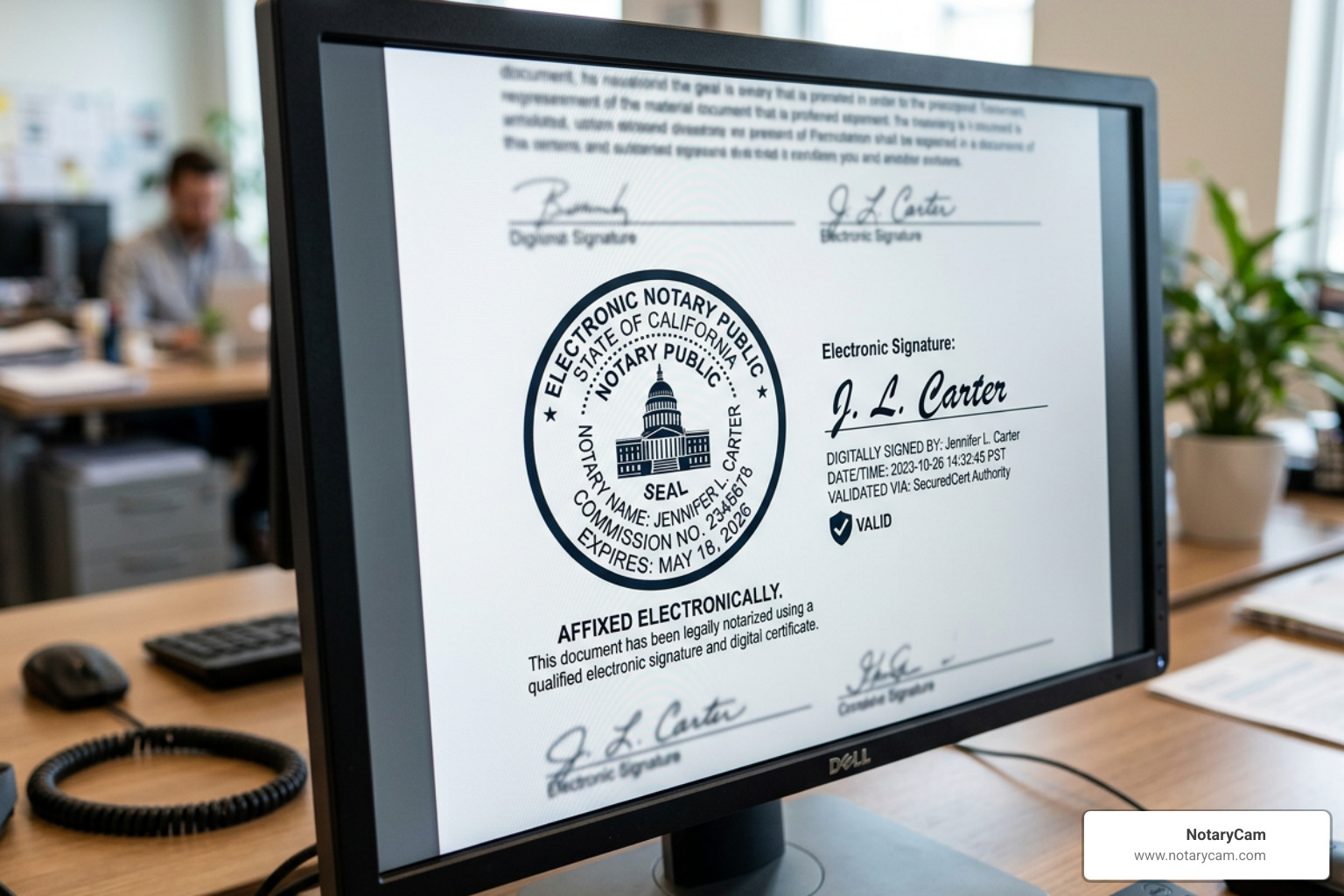
Audit trails are another essential feature, providing a chronological record of actions taken during the signing process. When a document is finalized, a tamper-evident seal is applied. If someone changes the document after it has been notarized, the digital seal can show that the file has been altered, which may affect reliance on the notarization.
Identity Verification on a Digital Notarization Secure Platform
To prevent digital identity fraud, platforms use a layered approach to verify signers. This often starts with Knowledge-Based Authentication (KBA), where the signer answers questions generated from public records. Following this, the signer may complete credential analysis, which uses a third-party vendor to authenticate the signer’s government-issued photo ID.
Participants need a device with webcam and audio capabilities, a reliable internet connection, a browser like Google Chrome for the live notarization session.
Integration and Scalability Considerations
For enterprise teams, a RON platform is only as useful as its ability to fit into existing operations. A solution that requires staff to jump between systems or manually re-enter data creates friction that can offset the efficiency gains of going digital in the first place.
Mature platforms in this space typically offer API integrations that allow organizations to embed notarization workflows directly into their own applications, document management systems, or customer portals. Most maintain a developer API that organizations can use to trigger notarization workflows programmatically, which can reduce manual handoffs and context switching across teams. As with any integration, your IT team should evaluate authentication flows and data handling requirements during the scoping process.
Scalability is worth examining closely during vendor evaluation. Enterprise document volumes often fluctuate, peaking at quarter-end, during high-volume lending periods, or around regulatory deadlines. A platform’s ability to handle those spikes without degrading the signer experience or notary availability can make a meaningful difference in operational reliability.
It is also worth asking vendors how they handle regulatory updates. RON laws continue to evolve at the state level, and a platform that monitors those changes and updates its compliance logic accordingly can reduce the burden on your internal legal and operations teams.
Step-by-Step Process for Online Notarization
Understanding the general workflow can help enterprise teams anticipate what their end clients will experience and where the process fits into a larger document pipeline.
A typical RON session begins when either the signer uploads their document or when the signer receives the link to complete the first of the identity proofing steps, credential analysis or the authentication o the signer’s government-issued photo ID verification. Credential analysis may be completed prior to the session or during the session, and the second part of identity verification is Knowledge Based Authentication is completed on camera in the room. The signer then provides eSign consent,, applies their electronic signature, and receives a tamper-evident notarized document once the session is complete.
From an operational standpoint, sessions typically run under 30 minutes for straightforward documents. The digital audit trail generated during each session, including the notary’s electronic journal entry, can support both regulatory recordkeeping and internal audit needs.
Note: RON laws vary significantly from state to state. Some states have comprehensive frameworks supporting remote sessions, while others may have restrictions or different requirements. Before implementing a digital notarization secure platform, check with your state’s regulatory authorities and consult with an attorney familiar with local laws in your jurisdiction. Participants need a device with computer, laptop, or tablet with audio and video capabilities, as well as a reliable internet connection.
Legal and Interstate Recognition: Building Operational Consistency Across Jurisdictions
For enterprise teams operating across multiple states, the question of RON legal recognition is really two questions. The first is whether a notarization is legally valid. The second, and often more operationally complex, is how to build workflows that account for varying state rules without creating a patchwork of manual exceptions.
Most states now have RON legislation, and many recognize notarizations performed legally in another state, though acceptance can still depend on the receiving party, such as a recording office, lender, or court. The practical challenge for enterprise teams is that keeping track of which rules apply to which transaction, in which state, for which document type, can become difficult to manage at scale without the right infrastructure in place.
One approach is to work with a platform that actively monitors regulatory changes and routes transactions to appropriately commissioned notaries based on the jurisdiction requirements of each session. This can shift some of the compliance monitoring burden from your internal teams to the platform, though it does not eliminate the need for legal oversight entirely.
Building a multi-state RON workflow that holds up operationally typically requires input from legal counsel familiar with each relevant jurisdiction, a platform with clear documentation of its compliance approach, and an internal process for flagging document types or states that may require special handling. Organizations that take time to map those variables before full deployment tend to encounter fewer exceptions once they are operating at volume.
Note: Notarization laws vary significantly from state to state. Some states have comprehensive frameworks supporting interstate recognition, while others may have restrictions or different requirements. Before implementing a digital notarization secure platform, check with your state’s regulatory authorities and consult with an attorney familiar with real estate and contract laws in your jurisdiction to ensure compliance with current local legislation. Participants need a device with webcam and audio capabilities and a reliable internet connection.
Audit Readiness and Record Retention
Enterprise organizations in regulated industries often face document retention requirements that go well beyond what state notary laws mandate on their own. A financial services firm subject to federal oversight, or a healthcare organization operating under HIPAA, may need to retain notarization records for years longer than the minimum a state notary journal requires.
A digital notarization platform can support those needs by generating a comprehensive audit trail for every session. This typically includes a video recording of the notarization, identity verification results, timestamps, and the notary’s electronic journal entry. That level of documentation can be considerably more detailed than what a paper-based notarization produces, which can be useful when regulators, auditors, or legal counsel need to reconstruct a transaction after the fact.
When evaluating platforms, it is worth asking specifically about storage architecture, access controls, and retention policy flexibility. Some organizations may need tiered storage options that balance cost with retrieval speed, or role-based access that limits which staff members can pull session records. Platforms that hold certifications such as SOC 2 Type II have had their security and availability controls independently reviewed, which can provide a useful baseline when assessing whether a vendor meets your organization’s data governance standards.
One practical consideration: retention requirements can vary not just by industry but by document type and jurisdiction. Working with legal counsel to map your retention obligations before selecting a platform can help ensure the solution you choose is actually configured to meet your specific needs, rather than just your state’s default notary journal rules.
Frequently Asked Questions
What documents can be notarized on a digital notarization secure platform?
Most documents that are eligible for traditional notarization can also be notarized online, including affidavits, powers of attorney, and real estate deeds. Some states may place limits on certain document types, such as wills, codicils, or documents tied to specific local filing rules. It is a good idea to confirm both state requirements and the receiving party’s acceptance policy before scheduling a session.
Is online notarization legal in all 50 U.S. states?
Many states have passed their own RON laws, while others have narrower rules or different procedures. A document notarized through a compliant process in one state may be recognized in another, but acceptance can still depend on the agency, court, lender, or recording office involved. Because requirements vary, it helps to verify the specific rules that apply to your transaction.
What equipment do I need for a RON session?
You typically need a computer, tablet, or laptop with a working webcam and microphone. A stable internet connection is also important because the notary must be able to see and hear the signer in real time. Most platforms run in a standard browser, though some may have additional technical requirements depending on the type of document or identity checks involved.
How is my identity verified during the process?
Identity verification usually includes Knowledge Based Authntication and credential analysis. You may be asked to answer questions based on available records, then upload or scan a government-issued photo ID for review. Some platforms also use biometric comparison to help assess whether the live signer matches the ID image.
How long does a digital notarization session typically take?
A standard digital notarization session often takes about 30 minutes, though the timeline can vary. Identity checks, document complexity, and signer readiness can all affect the total time. Even so, many users find the online process more efficient because it removes travel and paper handling.
Is a digital notarization secure platform safe for sensitive documents?
A digital notarization secure platform can be designed to handle sensitive documents by using multiple layers of security and identity verification. Many platforms use encryption to protect documents while they are uploaded, transmitted, and stored, which can help reduce the risk of unauthorized access. In addition, access controls and authentication processes may limit who can view or interact with a document during the notarization session.
Most platforms also include identity verification steps such as Knowledge-Based Authentication (KBA) and government ID credential analysis. Credential analysis may be completed prior to the session or in the signing session.. During the session, the notary and signer typically connect through live audio-visual technology so the notary can see and hear the signer in real time.
Another layer of protection often comes from the digital audit trail created during the session. Many platforms record the notarization and the notarized document generally includes a tamper-evident seal, which may indicate if the document is altered after the notarization is completed. These records can be useful if a transaction is later reviewed by legal teams, auditors, or regulators.
Even with these protections, organizations should evaluate a platform’s security architecture, certifications, and data handling practices before using it for highly sensitive documents. Security professionals often recommend reviewing factors such as encryption standards, access controls, and certifications like SOC 2 Type II. As with any notarization process, requirements and legal frameworks can vary by state, so it is wise to consult legal counsel when determining whether a digital notarization secure platform is appropriate for a particular use case.
Conclusion
For organizations that handle large volumes of contracts, real estate documents, or regulated paperwork, a digital notarization secure platform can be a practical way to modernize the notarization process. Instead of relying on in-person meetings and paper-based workflows, teams may be able to complete notarizations through secure video sessions supported by identity verification and encrypted document handling. Many organizations find that this approach can help streamline operations while creating a more detailed record of each transaction.
A well-designed platform may also support stronger operational visibility. Features such as session recordings, digital audit trails, and tamper-evident documents can make it easier for teams to review transactions later or respond to internal audits and regulatory inquiries. For enterprises managing transactions across multiple locations or jurisdictions, these capabilities can provide a more consistent process than traditional notarization methods alone.
At the same time, organizations evaluating a digital notarization secure platform should consider how the solution fits into their broader document workflows. Integration options, record retention capabilities, security certifications, and notary availability can all influence whether a platform works effectively at scale. Because notarization and Remote Online Notarization (RON) laws vary by state, it is also important to review applicable regulations and consult legal counsel before implementing a new workflow.
Platforms such as NotaryCam specialize in Remote Online Notarization and related services, which may help organizations support both traditional and remote notarization needs within a single system. As more businesses continue moving toward digital-first operations, a digital notarization secure platform can become an increasingly useful tool for managing secure document execution in a distributed environment.



 Your Privacy Choices