



Disclaimer: This blog post is for informational purposes only and does not constitute legal advice. Please consult an attorney for guidance on specific laws regarding Remote Online Notarization (RON), digital signatures, and related legal matters. As laws concerning RON and notarization are subject to frequent changes, it is advisable to verify current regulations with your local government.
If your institution is evaluating a remote online notary platform, here is a quick orientation before we go deeper:
Top reasons banks and financial institutions are adopting RON platforms:
- Remote Online Notarization (RON) allows notaries to perform notarial acts over a secure live audio-video connection, using digital signatures and electronic seals.
- RON platforms can replace in-person notarization for many high-volume document types, including loan modifications, lien releases, powers of attorney, and affidavits.
- Enterprise-grade platforms typically offer identity verification (KBA, biometrics, credential analysis), full audit trails, and compliance certifications such as SOC 2 and MISMO.
- RON notarizations performed under a notary’s commissioned state law may be recognized across U.S. states, which can support multi-state lending and servicing operations.
- Integration options often include APIsand eClosing platform partnerships, which can make RON scalable for high-volume workflows.
- Signers typically need a desktop or laptop with a webcam, microphone, and reliable internet connection to participate in a session.
Think about the last time a loan closing got delayed because a borrower could not physically get to a notary. Or the last time a document had to be re-executed because a notary seal was missing or incorrect. For enterprise teams managing hundreds or thousands of notarizations each month, these are not rare edge cases. They are daily operational friction points that can erode margins, extend loan cycles, and frustrate customers who expect a digital-first experience.
The financial services industry has made enormous investments in digital transformation, from online applications to automated underwriting. Yet the notarization step has often remained stubbornly analog, a paper-and-pen bottleneck sitting right in the middle of otherwise modern workflows. That gap is exactly what a secure remote online notary platform is designed to help close.
With RON laws now enacted across a broad majority of U.S. states, the legal foundation for digital notarization has matured considerably. The question for most banks and lenders today is no longer whether RON can be legally viable. It is which platform offers the right combination of security, compliance support, and enterprise-grade integration to make it operationally sustainable at scale.
Note: RON laws vary significantly from state to state. Some states have comprehensive frameworks supporting remote online notarization, while others may have restrictions or different requirements. Before implementing a RON platform, check with your state’s regulatory authorities and consult with an attorney familiar with notarization laws in your jurisdiction to verify compliance with current local legislation.
The Strategic Value of a Remote Online Notary Platform in Banking
In the high-stakes world of finance, the shift toward a remote online notary platform is increasingly viewed as a strategic move to support ROI and operational efficiency. When we look at the traditional “wet-ink” process, the costs are often hidden but substantial. There is the cost of courier services, the administrative time spent tracking down missing signatures, and the opportunity cost of capital tied up in longer closing cycles.
By adopting a digital-first strategy, banks may be able to compress these timelines considerably. A process that once took days of mailing and scheduling can often be completed in a fraction of that time. This speed can directly impact the bottom line by allowing lenders to fund loans faster and improve liquidity. Additionally, because a Remote Online Notary Platform provides a centralized digital record, the risk of lost or tampered documents may be significantly reduced.

Legally, the landscape has matured rapidly. While specific requirements vary, the legal framework for RON is now well-defined in the majority of U.S. states. Most jurisdictions recognize that a properly executed RON act may carry the same legal weight as an in-person notarization, though this can depend on the specific state, the transaction type and other factors. For banks, interstate recognition is an important consideration. It may allow a notary commissioned in one state to serve a signer located anywhere, provided the notary follows the laws of their own state.
How Lenders Integrate Remote Online Notarization into Enterprise Workflows
For enterprise buyers, the true power of a remote online notary platform lies in its ability to integrate seamlessly into existing workflows. We often see that the most successful implementations are those where the notary session feels like a natural extension of the loan application process.
Lenders typically explore several key integration points:
- eClosing Platforms: For mortgage lenders, RON is often described as the “final mile” of the eClosing journey. Integrating with eClosing providers can help ensure that critical documents are notarized in a secure, synchronized environment.
- API Connectivity: For organizations with custom needs, a remote notary software platform with a robust API can be essential. This may allow developers to build custom triggers, for example, automatically sending a vendor agreement for notarization once approved by the legal department.
- Title and Settlement Workflows: Cooperation between lenders and title companies is important. A shared digital platform may allow both parties to view the status of a signing in real time, helping confirm that all conditions for funding are met.
Security, Compliance Support, and Fraud Prevention in Digital Notarization
One of the more common misconceptions is that “online” means “less secure.” In practice, a high-quality remote online notary platform often incorporates security measures that go well beyond traditional in-person methods. Consider a standard notary visit: the notary reviews a driver’s license, perhaps compares the photo to the person in front of them, and signs a paper journal. There is typically no third-party verification of the ID’s security features and no permanent recording of the interaction.
Digital notarization generally takes a more layered approach:
- Identity Proofing: Signers typically pass Knowledge-Based Authentication (KBA), answering personal questions drawn from credit and public records.
- Credential Analysis: The platform may use a third-party vendor to analyze the signer’s government-issued ID, checking for watermarks, microprinting, and other security features.
- Audit Trails and Recordings: Sessions are generally recorded (audio and video) and stored securely. This can serve as a deterrent against fraud and may provide supporting evidence if a transaction is ever challenged.
- Certifications: Reputable platforms often maintain security certifications such as SOC 2 Type II and ISO 27001. MISMO certification is also commonly required for mortgage-related transactions, as it helps demonstrate that the platform meets standards relevant to the secondary mortgage market.
For a broader look at how these standards are applied, the National Notary Association provides an excellent overview of platform expectations and compliance.
Scaling Operations with Digital Tools
Scalability is a primary reason many B2B enterprises are moving away from traditional notarization. When processing hundreds of documents a day, the model of “find a notary, schedule a time, meet in person” can quickly become unsustainable.
| Feature | Traditional Notarization | Remote Online Notarization (RON) |
| Turnaround Time | 24–72 Hours (includes travel/mail) | 15–30 Minutes* |
| Identity Verification | Visual inspection by notary | KBA + Third-Party Credential Analysis |
| Audit Trail | Paper Journal | Video Recording + Digital Audit Log |
| Availability | Business Hours | 24/7 On-Demand** |
| Cost Efficiency | High (Travel fees, couriers) | Low (Flat per-seal/session fees) |
*Timing may vary depending on session complexity and signer preparation
**Only for non-real estate transactions. All other transaction are required scheduling.
A remote online notary platform may also support bulk document processing, allowing complex packages with multiple signers to be completed in a single, streamlined session. This can be especially valuable for mortgage lenders and servicers handling high volumes of lender acknowledgments, lien releases, or similar documents that often require coordination across multiple parties and time zones.
Streamlining High-Volume Documents with a Remote Online Notary Platform
In banking, certain document types are known for causing administrative delays. Loan modifications, for instance, often rely on the signer being able to meet in person and have no guardrails to ensure the notarization is completed in a timely or correctly. Using a remote online notary may reduce errors, increase visibility into the transaction, be more convenient, and improve the likelihood of timely completion.
Similarly, HELOCs and assumption documents are often good candidates for RON. By reducing the physical barrier to notarization, banks may be able to process these requests more efficiently. Internal vendor agreements and corporate resolutions can also be moved to a digital workflow, helping the bank’s own operations keep pace with its customer-facing processes.
Enhancing Customer Experience via a Remote Online Notary Platform
Customer expectations have shifted considerably. If someone can deposit a check or apply for a mortgage on their phone at 10 PM, they may expect to complete notarization steps just as conveniently. Platforms that offer anytime, anywhere access to notaries can improve customer satisfaction by reducing friction and wait times through convenient scheduling.
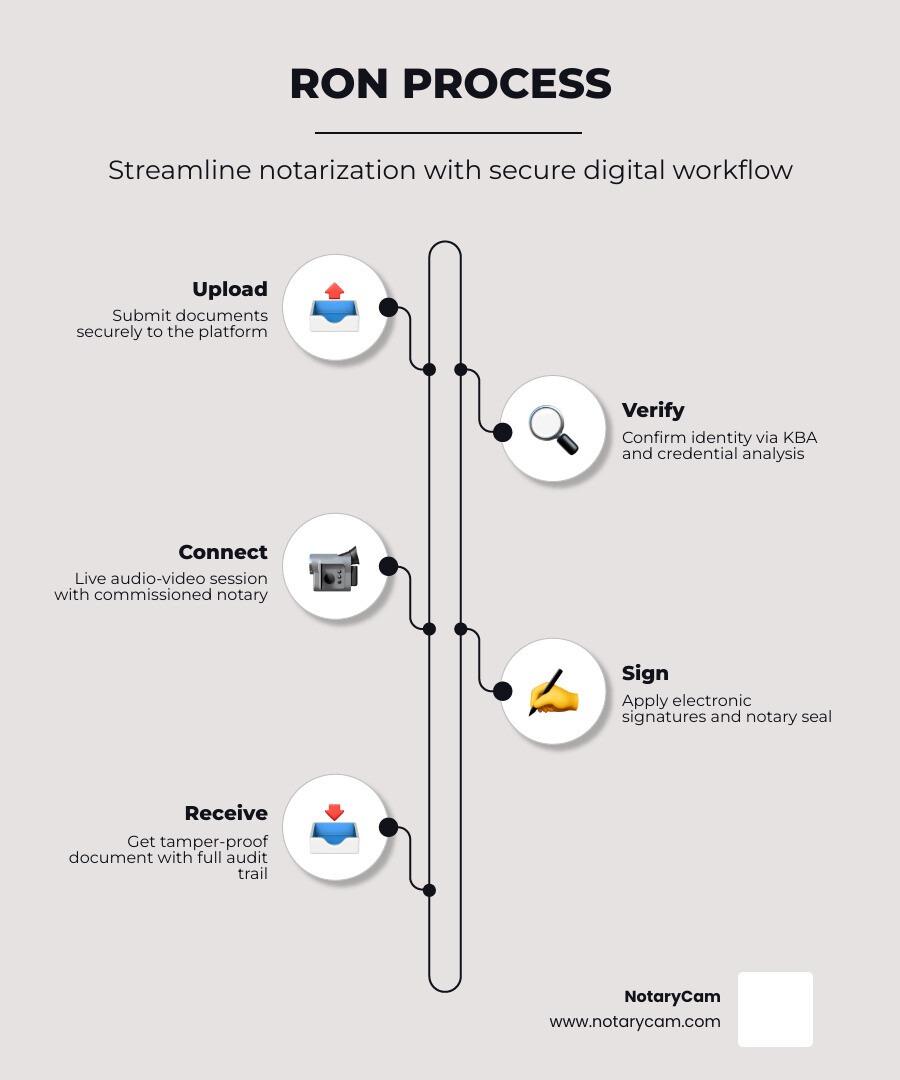
When a customer asks how online notarization works, the answer is generally straightforward: upload your document, verify your identity, and connect with a professional over video. Reducing turnaround time from days to minutes can reflect well on the institution and help build customer trust.
Technical Requirements and Implementation for Corporate Teams
While the process is designed to be user-friendly, there are specific technical requirements that corporate teams should communicate to their signers. To participate in a RON session, participants typically need:
- A device with webcam and audio capabilities, so the notary can clearly see and hear the signer. Note that many professional platforms may not support mobile devices for the signing session itself, so it is worth confirming requirements with your platform provider.
- A reliable internet connection, which is important for the continuous live audio-video recording that most RON laws require.
- A modern browser, typically the latest version of Chrome, Edge, or Safari.
Implementing RON at a corporate level involves more than purchasing a license. It typically requires training for internal notaries (if applicable) or establishing clear procedures for using a third-party notary pool. Most platforms offer a demo or sandbox environment where teams can practice before going live with real customers.
Note: RON laws vary significantly from state to state. Some states have comprehensive frameworks supporting remote online notarization, while others may have restrictions or different requirements. Before rolling out a RON platform across your organization, consult with an attorney familiar with notarization laws in each relevant jurisdiction to help verify compliance with current local legislation.
Frequently Asked Questions about Remote Online Notarization
How do mortgage lenders typically use remote online notarization?
Lenders often use RON to facilitate eClosings, which may allow borrowers to sign and notarize the deed of trust and other recordable documents digitally. It is also frequently used for trailing documents or post-closing corrections that would otherwise require a second in-person meeting. The applicability of RON for specific mortgage document types can depend on state law and investor requirements, so consulting with legal counsel and reviewing GSE guidelines before implementing is advisable. Platforms like NotaryCam specialize in supporting these workflows for financial institutions.
Can businesses notarize documents remotely across state lines?
In many cases, yes. Under the general principle of interstate recognition, a notarization performed by a notary commissioned in a state that authorizes RON may be recognized as valid in other states, provided the notary followed their home state’s laws. However, this can vary depending on the states involved and the document type. Consulting with legal counsel for any specific cross-state transaction is strongly recommended to confirm how interstate recognition may apply in your situation.
How do organizations typically integrate remote online notarization into enterprise workflows?
Integration is typically achieved through APIs. This may allow notarization requests to be triggered automatically based on a milestone in the workflow, such as when documents are ready for signing. The right integration path often depends on your existing technology stack, so discussing options directly with your platform provider to understand what is supported is a good first step.
What is the difference between RON and traditional notarization for financial services?
The primary difference is the medium of the interaction. Traditional notarization requires physical presence and paper documents, while RON uses live video technology and electronic documents. RON platforms generally incorporate additional identity verification steps, such as KBA and third-party credential analysis, that are not typically part of an in-person notarization. Both methods can produce legally valid notarizations, though the specific requirements and recognition can vary by state and document type.
Conclusion
Digital transformation continues to reshape expectations in financial services, and the notarization step is no longer an exception. A well-chosen remote online notary platform can help reduce operational friction, support faster loan cycles, and provide a more convenient experience for customers and staff alike.
That said, RON is not a one-size-fits-all solution. The right approach depends on your institution’s specific needs, technology infrastructure, and the states in which you operate. Evaluating platforms for security certifications, integration capabilities, and notary network availability can help narrow the field considerably.
NotaryCam is one option worth exploring for financial institutions looking to modernize their notarization workflows. As with any significant operational change, working with legal and compliance teams throughout the implementation process can help set the transition up for success.
Learn more about NotaryCam’s solutions for the financial sector.



 Your Privacy Choices