



Disclaimer: This blog post is for informational purposes only and does not constitute legal advice. Please consult an attorney for guidance on specific laws regarding Remote Online Notarization (RON), digital signatures, and related legal matters. As laws concerning RON and notarization are subject to frequent changes, it is advisable to verify current regulations with your local government.
A notary signature plays a critical role in verifying identity, documenting intent, and supporting trust in legal and financial transactions. Whether completed in person or through Remote Online Notarization (RON), the notary signature helps confirm that the signing process was properly witnessed and executed.
A notary signature is the point at which a commissioned public official puts their professional credibility on the line, certifying that identity was verified, that the signer appeared willingly, and that the document was properly executed. That core function has not changed with the shift to digital. What has changed is where it happens, how it is applied, and what it means for notaries who want to grow their practice.
Remote Online Notarization (RON) has created meaningful new opportunities for commissioned notaries. Rather than being limited to signers who can travel to a physical location, online notaries can serve clients across broader geographies, work with more flexible schedules, and build a practice that is not constrained by their immediate area. Understanding how the notary signature works in a RON environment, and selecting the right platform to support it, are the first steps toward building an online notarization practice.
What Is a Notary Signature?A notary signature is the official signature applied by a commissioned notary public to certify that a signer’s identity was verified, the signer appeared willingly, and the notarial act was completed according to state law. |
Why Notary Signatures Matter
A notary signature plays an important role in establishing trust and authenticity in legal and financial transactions. By confirming identity, witnessing signatures, and applying an official notarial seal, the notary helps create a formal record that the document was executed properly.
Notary signatures can help deter fraud by requiring identity verification and creating accountability around the signing process. In many industries, including real estate, financial services, legal services, and estate planning, notarized documents are relied upon because they provide an additional layer of verification and evidentiary support.
In Remote Online Notarization (RON), the notarization process is completed digitally through secure video technology, electronic signatures, identity authentication tools, and tamper-evident audit trails designed to support document integrity and compliance.
Because notarized documents are often relied upon in high-value legal and financial transactions, the notary signature serves as an important safeguard against disputes, impersonation, and improperly executed documents.
What Is a Notary Signature? And What Does it Certify?
A notary signature is more than a formality. When a commissioned notary public signs and seals a document, they are certifying several specific things: that the signer appeared before them, that their identity was verified through acceptable means, that they appeared to be signing willingly and without coercion, and that the notarial act was completed in accordance with the laws of the notary’s commissioning state.
This certification carries legal weight because it is backed by the notary’s commission, which is granted by state government and can be revoked if a notary acts improperly. That accountability is what gives the notary signature its value. It creates a formal record that a qualified, impartial official oversaw the signing, which can help deter fraud and provide a basis for legal recourse if the document’s authenticity is later challenged.
In practical terms, a properly executed notary signature, along with the official seal, can be required for documents such as real estate deeds and mortgage closing packages, powers of attorney, affidavits and sworn statements, loan agreements, and certain estate planning documents. The specific requirements vary by document type and state law.
A valid notary signature requires that the notary properly verify the signer’s identity, witness the signing process, and complete the notarial act according to applicable state law. If those requirements are not followed, the notarization could later be challenged, rejected, or deemed invalid.
In a Remote Online Notarization (RON) environment, these same standards are fulfilled digitally through identity verification technology, secure audio-video communication, electronic signatures, and detailed audit trail documentation.
What Is a Digital Notary Signature in Remote Online Notarization (RON)?
A digital notary signature is the electronic signature applied by a commissioned notary public to complete a notarial act during a Remote Online Notarization (RON) session. Instead of signing a document with ink, the notary applies a digital signature and electronic notarial seal through a secure notarization platform.
Many RON platforms use digital certificate technology, often based on Public Key Infrastructure (PKI), to link the notary’s identity to the document. This process can create a tamper-evident seal that may help reveal if the document is altered after notarization.
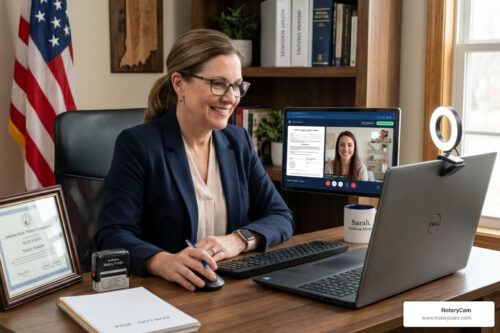
To participate in a RON session, both the notary and the signer generally need a device with webcam and audio capabilities and a reliable internet connection, along with access to a compliant RON platform.
Note: Remote Online Notarization laws vary significantly from state to state. Before performing RON, notaries should verify their state’s rules and consult appropriate regulatory authorities if needed.
Traditional Notary Signature vs Digital Notary Signature
While the core legal purpose of a notary signature remains the same, the process and technology behind digital notarization differ from traditional in-person notarization in several important ways.
| Traditional Notary Signature | Digital Notary Signature |
| Handwritten ink signature | Electronic signature |
| Physical stamp or seal | Digital notary seal |
| In-person notarization | Remote online notarization |
| Paper document workflow | Digital document workflow |
| Physical recordkeeping | Digital audit trail |
How the Notary Signature Works in a RON Session
In a Remote Online Notarization session, the notary signature serves the same legal function as it does in person, but it is applied electronically through a secure platform.
A typical RON notarization process often includes the following steps:
- Identity verification
The signer’s identity is reviewed using credential analysis, knowledge-based authentication, or other approved verification methods. - Live video notarization
The signer and notary connect through a secure video session so the notary can observe the signing and confirm the signer appears willing and aware. - Electronic document signing
The signer applies their electronic signature to the document while the notary witnesses the process. - Digital notary signature and seal
The notary applies their digital notary signature and electronic seal, completing the notarization. - Recording and audit trail creation
The platform records the session and stores an audit trail that may include timestamps, identity verification results, and document interaction logs.
For the signer, the experience generally mirrors an in-person notarization. They verify their identity, review the document, sign electronically, and receive a digitally sealed copy once the notarial act is complete.
Note: RON laws and technology requirements vary by state. Before performing remote notarizations, notaries should confirm their state’s specific requirements and ensure the platform they use meets those standards.
Identity Verification: The Foundation of Every Notary Signature
Whether a notarization takes place in person or online, the integrity of the notary signature depends entirely on the quality of the identity verification that precedes it. A notary’s signature certifies that identity was confirmed; if the verification was inadequate, the certification loses its value.
In a RON session, identity verification typically involves multiple layers. Credential analysis examines the signer’s government-issued ID for authenticity indicators such as security features, formatting, and expiration. Many RON platforms use Knowledge-Based Authentication (KBA), which may present the signer with questions derived from public records. It is designed to confirm that the person is who they claim to be. The notary then conducts live visual verification during the video session, confirming that the person on camera matches the ID and observing for any signs of coercion or confusion.
Together, these layers can provide a thorough verification process. For notaries, understanding how these tools work is important, not just for compliance, but because the strength of those verification steps directly supports the credibility of every notary signature you apply.
Growing Your Notary Practice with RON
For commissioned notaries, RON can open up a significantly broader range of opportunities than traditional in-person work alone. Geographic flexibility is perhaps the most immediate benefit: rather than being limited to clients who can come to you or whom you can travel to, RON allows you to serve signers in other cities, other states (subject to applicable state law), and sometimes internationally, all from your own workspace. As a reminder, the notarization is generally governed by the notary’s commissioning state, even if the signer is located elsewhere.
Scheduling flexibility is another practical advantage. Many RON platforms support sessions outside of traditional business hours, which can allow notaries to accommodate clients who work demanding schedules. For notaries looking to build volume, that flexibility can make a meaningful difference in how many sessions they are able to complete.
The demand side of the equation is also shifting. Industries including real estate, financial services, healthcare, and legal services are increasingly incorporating RON into their standard workflows. Notaries who are comfortable operating on a digital platform, completing sessions efficiently, and maintaining clean records are well positioned to serve these institutional clients, which often bring higher and more consistent transaction volume than walk-in individual signers.
Two Paths Forward with NotaryCam
For notaries looking to build or expand a RON practice, NotaryCam offers two distinct options depending on how you want to work.
Join NotaryCam as a Notary
If you are interested in working as a notary through an established platform without the overhead of running your own business, NotaryCam accepts applications for open notary positions. As a notary with NotaryCam, you would perform RON sessions through the platform’s infrastructure, serving clients across the industries NotaryCam supports, including real estate, financial services, legal, and more.
NotaryCam’s platform is backed by over a decade of experience and more than a million completed notarizations, which means the systems and processes are established. You focus on performing quality sessions; the platform handles the infrastructure.
If you are a commissioned notary who has completed your RON certification and are interested in working with NotaryCam, you can explore open notary positions on the NotaryCam website.
Use NotaryCam’s Independent Notary Software to Run Your Own Practice
If you prefer to operate independently and serve your own clients under your own brand, NotaryCam’s Independent Notary Software can provide the technology infrastructure to support that. The platform is designed specifically for notaries who want to perform RON sessions professionally, with the compliance features and security standards that institutional and individual clients increasingly expect.
The platform includes live video session capability, multi-layered identity verification tools, electronic signature functionality, PKI-based digital notary signatures and seals, and a secure digital journal with audit trail generation. Sessions are recorded.
The platform is SOC 2 compliant and MISMO certified, which are meaningful credentials when working with real estate lenders, title companies, and financial institutions that have specific vendor requirements. The Independent Notary Software starts with a 12-month contract, has no monthly minimums, and includes unlimited transactions on a single seat, along with access to training materials and email support.
Many states require notaries to use a state-approved or state-accepted platform when performing RON. Before subscribing to any platform, confirming that it meets your commissioning state’s requirements is an important step. The National Notary Association (nationalnotary.org) can be a useful resource for verifying state-specific RON certification and platform requirements.
Note: RON certification is a separate step from standard notary commissioning in most states. The requirements, training, and approval processes vary by state. Contact the NNA at 1-800-876-6827 or visit nationalnotary.org to learn about your state’s specific RON certification pathway before selecting a platform.
What to Look for in a RON Platform
Whether you are evaluating NotaryCam or any other RON platform, there are several practical considerations worth working through before committing.
Compliance with your state’s requirements is the starting point. Some states mandate the use of specific platforms or platforms that meet defined technical standards. Using a platform that has not been accepted in your commissioning state could put your notarizations at risk of being rejected or challenged.
Security and record-keeping capabilities matter for the long-term integrity of your work. Look for platforms that offer encrypted video sessions, tamper-evident document seals, detailed audit trails, and record retention that meets or exceeds your state’s minimum requirements. These features protect both you and the signers you serve.
Ease of use and support availability are practical considerations, particularly if you are new to RON. A platform that is difficult to navigate or slow to respond to support requests can create friction during sessions that reflects poorly on your professionalism, even when the issue is a platform problem rather than your own.
Finally, consider how the platform supports growth. Features like the ability to serve multiple clients, flexible session scheduling, and integration with common document workflows can make a meaningful difference as your practice volume increases.
Frequently Asked Questions
What is a notary signature, and what does it certify?
A notary signature is the official signature applied by a commissioned notary public to complete a notarial act. When a notary signs a document, they are certifying that the signer appeared before them (in person or via RON), that their identity was verified through acceptable means, that the signer appeared to be acting willingly and without coercion, and that the notarial act was performed in accordance with applicable state law. This certification is backed by the notary’s state-issued commission, which creates accountability and gives the signature its legal weight. The notary seal, applied alongside the signature, confirms the notary’s official status and commission details.
How is a digital notary signature different from a handwritten one?
In a RON session, the notary applies a digital signature rather than a handwritten one, but the legal function is the same: certifying that the notarial act was properly performed. Many RON platforms use PKI-based (Public Key Infrastructure) digital signatures, which can create a cryptographic link between the notary’s identity and the document. This means that any post-signing alteration to the document can be detected through the tamper-evident seal. The session recording and audit trail that accompany a RON notarization can provide additional documentation of the act that paper-based notarizations cannot replicate in the same way. The specific legal recognition of digital notary signatures depends on the laws of the notary’s commissioning state.
What does a notary need to perform RON?
To perform RON, a notary typically needs an active notary commission, a separate RON certification obtained through their commissioning state’s process, a compliant RON platform that meets their state’s technology requirements, and the equipment to support live video sessions, including a computer with a working webcam and microphone, and a reliable internet connection. RON certification requirements, including required training, fees, and approved platforms, vary significantly by state. The National Notary Association (nationalnotary.org) is a helpful resource for understanding what your specific state requires before you get started.
What is the difference between working as a contract notary and using independent notary software?
Working as a contract notary through a platform like NotaryCam means you perform sessions on behalf of the platform’s clients, using the platform’s infrastructure and accessing sessions that the platform coordinates. This can be a lower-overhead way to start performing RON and may provide more consistent session volume without the need for independent client acquisition. Using independent notary software, such as NotaryCam’s platform for independent notaries, means you run your own practice and serve your own clients using the platform as your technology backbone. You maintain more control over your schedule, pricing, and client relationships, but also take on more responsibility for growing and managing your business. Both paths have merit depending on your goals, experience level, and how you want to structure your work.
How can a notary build a sustainable RON practice?
Building a sustainable RON practice generally involves a few consistent elements: completing your state’s RON certification, selecting a platform that meets your state’s requirements and supports the types of sessions you want to perform, and developing relationships with the industries that generate regular notarization volume, such as real estate, financial services, and legal services. Performing sessions professionally and maintaining clean records can support your reputation over time, and notaries who become comfortable with institutional client requirements, such as SOC 2 compliant platforms or MISMO certification, may find it easier to access higher-volume referral sources. Staying current with changes in state RON laws is also important, as the regulatory environment continues to develop across many jurisdictions.
Can a notary use an electronic signature?
Yes, a notary can use an electronic signature in certain situations, particularly when performing Remote Online Notarization (RON) or other forms of electronic notarization. Instead of signing with ink, the notary applies a digital or electronic version of their signature along with an electronic notarial seal through an approved platform.
In many RON systems, the notary’s signature is applied using digital signature technology, which may include Public Key Infrastructure (PKI). This technology can create a cryptographic connection between the notary’s identity and the document and may make later alterations easier to detect through a tamper-evident seal.
However, the rules governing electronic notary signatures vary significantly by state. Some states require specific types of digital signatures or approved technology providers, while others have different standards for electronic notarization. Before using an electronic signature, notaries should confirm the requirements set by their commissioning state and ensure the platform they use meets those standards.
To perform remote notarization, the notary and signer typically need a computer or laptop with webcam and audio capabilities and a reliable internet connection, along with access to a compliant RON platform such as NotaryCam or another approved provider. Notaries may also need separate authorization or certification from their state to perform RON.
Conclusion
The notary signature remains one of the most trusted signals of document authenticity in the legal and financial system. What is changing is the context in which it is applied. Remote Online Notarization has expanded where and how that signature can be delivered, and for commissioned notaries who are prepared to work in that environment, the opportunity is real.
Understanding what your notary signature certifies, how identity verification supports that certification in a digital context, and what platform infrastructure you need to perform RON professionally are the practical foundations of building a credible online practice. Whether you are interested in joining NotaryCam’s network as a contract notary or prefer to run your own client-facing practice using independent notary software, the tools to do so are available.
The notaries who position themselves well in the RON space now, by getting properly certified, choosing compliant platforms, and developing familiarity with institutional client expectations, may find themselves well ahead as demand for remote notarization services continues to grow across industries.


 Your Privacy Choices