



Disclaimer: This blog post is for informational purposes only and does not constitute legal advice. Please consult an attorney for guidance on specific laws regarding Remote Online Notarization (RON), digital signatures, and related legal matters. As laws concerning RON and notarization are subject to frequent changes, it is advisable to verify current regulations with your local government.
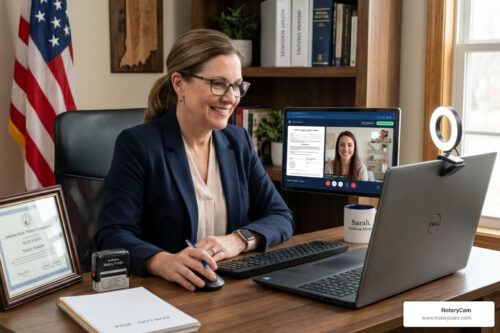
RON for property closing refers to completing a real estate transaction using two-way audio-visual technology. A commissioned notary and the signing parties connect through a secure online platform instead of meeting in person. This allows buyers, sellers, and notaries to handle signing and notarization through a live secure two-way audio video session.
Participants connect by webcam and microphone, and identity is verified through a layered process that includes credential analysis and knowledge-based authentication (KBA). To use RON services, participants need a computer, laptop or tablet with webcam and audio capabilities, plus a reliable internet connection. This setup can support a real estate transaction when parties are in different locations or coordinating around busy schedules.
Many states and the District of Columbia have enacted laws permitting RON for real estate financial transactions, although the specifics vary considerably from one jurisdiction to the next. Industry observers note that a typical RON closing session can be completed faster than a traditional in-person closing, which reflects how the industry has begun to rethink the final step of a property deal.
For title companies and lenders managing high volumes of closings, this shift can be an operational advantage. Scheduling conflicts and document errors often carry real costs, and RON offers a structured way to reduce them, supporting a more flexible workflow for modern real estate professionals.
Note: RON laws vary significantly from state to state. Some states have comprehensive frameworks supporting RON, while others may have restrictions or different requirements. Before implementing RON, check with your state’s regulatory authorities and consult with an attorney familiar with real estate laws in your jurisdiction.
Understanding RON for Property Closing
At its core, RON for property closing uses secure two-way audio-visual technology to bridge the distance between a notary and a signer. The method may replace the requirement for physical presence with remote presence, where the parties can see and hear each other in real time. By pairing remote notarization with electronic signatures, the full stack of closing documents can be executed without physical ink when used with an eNote. Industry groups such as the ALTA Online Notarization Advocacy effort have worked to establish standards for these digital interactions.
For many title agents and lenders, the shift to a RON closing can represent a move toward a more predictable workflow. Instead of waiting for a mobile notary or a physical document package, the session happens in a controlled digital environment. That setup can allow for better oversight and a cleaner record for compliance teams.
How Identity Verification Works in RON for Property Closing
Security is a primary concern in any real estate deal, and identity verification for RON for property closing is typically more rigorous than an in-person closing. The process generally begins with credential analysis, which uses a third-party vendor to authenticate the signer’s government-issued photo ID. This step can occur before or during the session, and helps confirm that the ID is authentic before notarization proceeds.
After credential analysis, signers usually undergo Knowledge-Based Authentication (KBA), which involves answering a series of questions generated from public records. Together, credential analysis and KBA form part of the multi-factor authentication approach that helps deter impersonation. These protocols are generally designed to align with MISMO RON Standards.
The Role of eNotes in RON for Property Closing
A digital mortgage often relies on the creation of an electronic promissory note, or eNote. In RON for property closing, the eNote can serve as the digital version of the borrower’s promise to repay the loan. The eNote is typically created as a SMART Doc, the MISMO standard format that keeps the document tamper-evident and transferable. These documents are typically registered with the MERS eRegistry, which helps identify the current controller of the note.
For lenders looking to move away from paper, understanding how eNotes work is a useful starting point. When an eNote is combined with RON, a fully digital eClose stack can become a reality, and that integration helps reduce the friction that can otherwise delay a loan’s lifecycle.
Benefits of Digital Real Estate Transactions
The move toward digital closings can offer practical advantages for many parties involved. For the buyer or seller, the benefit is often convenience, with no need to take time off work or coordinate childcare to visit a title office. This location independence can be especially helpful for military families and investors who may be far from the property.
There can also be a notable environmental benefit. By reducing the need for printed pages and travel, a remote closing can support sustainable business practices, and title companies may meaningfully reduce their reliance on paper and physical storage space.
Efficiency and Speed
Time can be a valuable resource in a real estate transaction. Industry observers note that a RON closing session often takes less time than a traditional closing, and for title companies, this efficiency may mean a single notary can handle more online closings per day compared to a traditional setting.
The reduction in travel time for notaries and signers alike can help keep the closing schedule on track. By utilizing shorter closing meetings and pre-review periods, title companies can clear their pipelines more efficiently.
Accuracy and Flexibility
The digital format can also reduce errors, since documents may be reviewed for completeness before the closing begins. Signers can review their documents ahead of time, which gives them a chance to raise questions early. And when last-minute changes are needed, digital documents can typically be updated more easily than their paper counterparts.
Enhanced Security Features
Many practitioners find that RON for property closing is usually more secure than signing paper documents in person. Every session is recorded, which creates an audio-visual record of the signing. Digital seals and tamper-evident technology help indicate when a document has been altered after execution.
Platforms also use audit trails to track actions taken during the session, and some protocols include room scans intended to help confirm the signer is not being coerced. Multi-factor authentication is what makes it more difficult for bad actors to impersonate signers, while the audit trail helps detect and validate document tampering after the fact. According to a Consumer Financial Protection Bureau study, borrowers using eClosings reported greater feelings of empowerment, better understanding of the process, and improved efficiency compared to those using paper closings.
The Step-by-Step RON Closing Process
Navigating a RON for property closing is a structured process that begins before the video call starts. The first phase involves document preparation, where the title company or lender uploads files to a secure platform. Documents are tagged for signatures and notary seals so the live session can run efficiently.
A key part of the RON process is the pre-review period. Borrowers are typically given access to their documents in advance, which allows them to read through the fine print at their own pace and may reduce questions during the actual notarization. By the time everyone arrives at the virtual table, they are usually ready to sign.
Document Preparation and Distribution
The transition to eClosings requires a shift in how documents are distributed. Instead of printing large packets, files are delivered electronically to the signer’s secure portal, which helps reduce the risk of documents being lost or delayed in transit.
During this stage, digital platforms incorporate structured workflows to help ensure notary credentials are applied correctly and required fields are completed before finalization, which reduces the need for re-execution. For the borrower, the ability to review documents digitally can make the process feel more transparent.
The Live Notarization Session
When it is time for the e-close, the signer and notary log into a secure virtual room and connect through a live secure two-way audio video session. They must be able to see and hear each other clearly. The session opens with identity proofing steps, starting with credential analysis followed by KBA. These steps can also be completed ahead of time to speed up the process.
Once identity is confirmed, the notary guides the signer through the documents. The signer applies their digital signature, and the notary applies their electronic seal and digital certificate, which acts as a tamper-evident seal for the document. The interaction is recorded and archived to provide a robust record of the transaction.
Note: Notarization laws vary significantly from state to state. Some states have comprehensive frameworks supporting RON, while others may have restrictions or different requirements. Before implementing RON, check with your state’s regulatory authorities and consult with an attorney familiar with real estate laws in your jurisdiction.
Legal Landscape and State Adoption
The legal framework for RON for property closing has expanded considerably over the past several years. Many states and the District of Columbia have enacted permanent RON laws, an outcome shaped in part by advocacy from organizations such as the MBA and ALTA. At the federal level, legislation has been introduced to promote interstate recognition of remote notarizations.
For mortgage professionals, staying updated on the MBA RON Adoption Map can be helpful. While most states allow some form of RON, the specific requirements for record keeping and identity verification can vary, and understanding those nuances is important for transactions involving parties across state lines. Articles touching on international use cases should also note that a US nexus is generally required.
Investor and Agency Acceptance
A common question is whether major investors can buy loans closed with RON. Fannie Mae and Freddie Mac both publish guidelines for accepting remotely notarized security instruments, and lenders are typically required to flag remotely notarized loans appropriately at delivery. State-specific rules within their seller guides can also apply, so confirming current requirements for each transaction is generally advisable.
Government agencies including the FHA and VA have also moved to support digital options. This acceptance has helped make RON more common among title companies and lenders, although it is generally a best practice to confirm with the specific lender that they are comfortable with the digital format for a given loan.
Compliance and Standards
To support a smooth secondary market execution, RON platforms generally adhere to industry standards. MISMO certification is often regarded as a high standard in this area, helping confirm that the platform meets requirements for identity verification and audio-visual quality.
Following recognized eClosing standards can help reduce risk for participants and helps confirm that digital files are compatible with the systems used by lenders and investors. As more jurisdictions move toward eRecording, having a standardized digital document can make the final step of public recordation more efficient.
Frequently Asked Questions
What is the difference between RON and hybrid closings?
A hybrid closing typically involves some documents being signed electronically while others are signed in person with a physical notary. In contrast, a RON closing allows all documents to be signed and notarized digitally through a live secure two-way audio video session. This method can provide a fully remote experience for the parties involved, which may eliminate the need for any physical meeting. The right approach often depends on state law, investor requirements, and the preferences of the title company or lender.
Is RON suitable for FHA and VA loans?
Many major investors and agencies, including the FHA and VA, accept documents executed via RON when specific guidelines are met. It is important to verify that the chosen platform and the specific transaction comply with current agency requirements. Lenders can help confirm whether a particular loan type is eligible for a digital closing based on their internal policies, and requirements may change as agencies update their guidance.
How long does a typical RON session take?
Industry observers report that RON closing sessions are often shorter than traditional in-person closings, in part because participants typically receive documents in advance and can review them before the meeting. A CFPB study on eClosings found that early document delivery and review correlated with shorter closing meetings. Actual session length can vary based on the complexity of the transaction, the number of documents, and how prepared the signers are.
What technical equipment do I need?
To use RON services, participants need a computer, laptop or tablet with webcam and audio capabilities, plus a reliable internet connection. Most RON platforms are designed to work with current versions of common web browsers. For title companies and lenders, confirming hardware and connectivity standards across the team in advance can help reduce delays at session time.
Are there extra costs for RON?
The costs associated with RON closings are often comparable to traditional in-person notary fees or mobile notary travel charges. While there may be a technology fee for using a secure platform, these costs can be offset by savings on travel, courier services, and time. Many title companies and lenders find that the increased efficiency provides a meaningful financial benefit when measured across higher transaction volumes.
Conclusion
The shift toward digital real estate transactions reflects a meaningful evolution in how property is bought, sold, and financed. By utilizing RON for property closing, title companies and lenders can offer a more flexible and well-documented experience that meets the modern expectations of buyers and sellers. This approach can help resolve common pain points such as scheduling conflicts and the need for physical travel, while supporting tighter timelines and cleaner records.
As the industry continues to adopt these tools, staying informed about state-specific regulations and technical requirements remains essential. Platforms such as NotaryCam are one example of how organizations support various digital closing methods, helping confirm that documents are handled with appropriate security and that the process aligns with applicable industry standards.
Implementing digital closing solutions can lead to measurable improvements in transaction completion timelines and overall client satisfaction. By exploring how RON for property closing fits into existing workflows, title companies and lenders can position themselves to serve clients who increasingly expect digital options, while preparing for the continued evolution of real estate transactions.


 Your Privacy Choices