



Disclaimer: This blog post is for informational purposes only and does not constitute legal advice. Please consult an attorney for guidance on specific laws regarding Remote Online Notarization (RON), digital signatures, and related legal matters. As laws concerning RON and notarization are subject to frequent changes, it is advisable to verify current regulations with your local government.
Quick Answer: What is an online notary?
An online notary is a commissioned notary public who performs notarizations remotely using secure audio-visual technology instead of meeting in person.
If you’ve ever found yourself scrambling to find a notary before a deadline, wondering whether you really have to drive across town for a ten-minute signature, you’re not alone. The good news is that for many people and many documents, there’s now a faster option: an online notary.
But what exactly is an online notary, and how does the process actually work? This guide breaks it down in plain terms, covering how online notarization differs from the traditional approach, what the step-by-step process looks like, what kinds of documents may qualify, and when an in-person notary might still be the right call.
What Is an Online Notary?
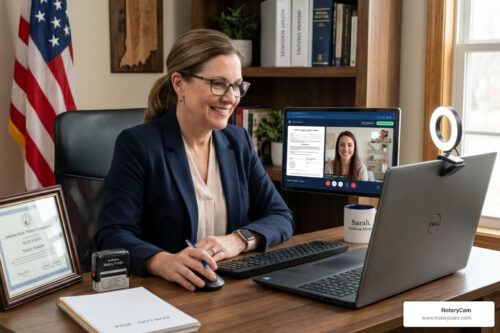
An online notary, sometimes called a remote online notary, is a commissioned notary public who performs notarizations electronically using audio-visual technology rather than meeting signers in person. The notary and signer connect over a secure video conferencing platform, the signer’s identity is verified digitally, documents are signed electronically, and the notary applies a digital seal, all without anyone needing to be in the same room.
Remote online notarization is also commonly referred to as RON. It’s worth knowing that terminology varies: you may see the terms “online notary,” “e-notary,” “virtual notary,” and “remote notary” used interchangeably, though they can have slightly different technical meanings depending on the state. For most practical purposes, they refer to the same general concept: notarization that happens remotely, over the internet.
How Online Notarization Differs from Traditional Notarization
Traditional notarization requires the signer to appear physically before a commissioned notary public. The notary checks the signer’s ID in person, witnesses the signing of the document, and affixes a physical stamp or seal. It’s a process that has worked for centuries, but it comes with real friction: scheduling around business hours, traveling to the notary’s location, and coordinating any additional witnesses who may be required.
Online notarization replaces the physical meeting with a secure digital one. The core legal purpose, verifying the signer’s identity and witnessing the signing, remains the same. What changes is how it’s done. Instead of presenting a physical ID, the signer verifies their identity through digital tools. Instead of a wet-ink signature, an electronic signature is captured. Instead of a rubber stamp, the notary applies a tamper-evident digital seal.
One practical difference worth noting: online notarization typically can create a more detailed record than traditional notarization. RON platforms generally retain a video recording of the session, a timestamped audit trail of every action taken, and an electronic copy of the notarized document, which can be useful if the document’s validity is ever questioned.
How the Online Notary Process Works
The specifics can vary somewhat by platform and state, but the general flow of a remote online notarization session tends to follow the same path.
Step 1: Choose a Platform and Upload Your Document
The process typically begins by selecting a RON platform and uploading the document you need notarized. Most platforms accept common file formats, and some can guide you through preparing the document if you’re starting from scratch. To complete the session, you’ll generally need a computer or laptop with a webcam and audio capabilities, plus a reliable internet connection.
Step 2: Verify Your Identity
Before the live session begins, you’ll go through an identity verification process. RON platforms typically use two main methods for this.
The first is credential analysis, where you upload or present a government-issued photo ID (such as a driver’s license or passport) and software examines the document’s security features, including things like holograms, microprint, and formatting, to help assess its authenticity.
The second is knowledge-based authentication (KBA), which involves answering a short series of multiple-choice questions drawn from your personal history, things like past addresses or financial records. These questions are designed to help confirm the signer’s identity. Some platforms or states may require both methods, and some may incorporate additional verification steps.
Step 3: Connect with the Online Notary via Video
Once your identity is confirmed, you’ll join a live, secure video session with a commissioned online notary. The notary can see and hear you in real time, review the document with you, confirm that you understand what you’re signing, and verify that you’re acting voluntarily. This live interaction is what is generally intended to satisfy the ‘personal appearance’ requirement under many RON statutes.
Step 4: Sign the Document Electronically
With the notary present on the video call, you apply your electronic signature to the document. The notary then applies their digital seal and signature. The resulting document typically includes a cryptographic certificate that makes any subsequent tampering detectable.
Step 5: Receive Your Notarized Document
After the session, you’ll generally receive a digital copy of the completed, notarized document. The platform will also retain a record of the session, including the video recording and audit trail, for the retention period required by your state’s laws.
Benefits of Using an Online Notary
For both individuals and small businesses, online notarization offers a number of practical advantages over the traditional approach.
Convenience and Flexibility
One of the most significant draws is the ability to get documents notarized from wherever you happen to be. For individuals, that might mean handling an urgent legal document from home without rearranging the workday. For small businesses that regularly deal with contracts, affidavits, or other notarized documents, being able to complete signings remotely can meaningfully reduce administrative friction.
Faster Turnaround
Traditional notarization can involve scheduling delays, travel time, and waiting. RON platforms typically allow sessions to be scheduled quickly, and some offer on-demand access, which can be particularly useful when a document needs to be executed under a tight deadline.
Accessibility
Online notarization may be especially valuable for people who face barriers to traditional in-person notarization, including those with mobility limitations, people in rural areas with limited local notary access, or individuals who are traveling or living abroad but need to execute a U.S. document.
A Stronger Audit Trail
Because RON sessions are recorded and generate detailed logs, the documentation of what took place during the signing can be more thorough than what a traditional paper notary journal typically captures. For businesses handling high-stakes agreements, that level of documentation may offer additional peace of mind.
What Documents Can (and Can’t) Be Notarized Online?
Many common document types may be eligible for remote online notarization, but the specific list varies by state. Where RON is permitted, documents that are often eligible include:
- Powers of attorney (general and healthcare)
- Real estate documents, including deeds and mortgage agreements
- Loan and refinancing documents
- Affidavits and sworn statements
- Business contracts and agreements
- Living wills and advance directives
However, some document types may be restricted from online notarization even in states that broadly permit RON. Wills and testamentary documents are a common example; some states require these to be notarized in person, while others allow remote execution under specific conditions. Court-ordered documents, certain real estate instruments, and documents with unusual witness requirements may also be subject to special rules.
Some RON platforms may apply additional requirements for certain document types. For example, NotaryCam may require that a licensed attorney be involved when notarizing certain documents, such as powers of attorney, through its platform.
Note: Online notarization laws vary significantly from state to state. Some states have comprehensive frameworks supporting RON for a wide range of documents, while others may have restrictions or different requirements. Before proceeding with remote online notarization, check with your state’s regulatory authorities and consult with an attorney familiar with notarization laws in your jurisdiction to confirm your document type is eligible.
When You Might Still Need an In-Person Notary
Online notarization is a genuinely useful option for many situations, but it isn’t always the right fit. There are several circumstances where in-person notarization may be required or more appropriate.
Some states have not yet enacted RON legislation, or have enacted it but not yet implemented it. In those jurisdictions, online notarization may simply not be available from a state-commissioned notary. Additionally, some documents specifically require in-person notarization by statute, regardless of what the state’s broader RON rules say.
The receiving party also matters. Even if your state permits RON, a financial institution, court, or government agency may have its own policies about which forms of notarization it will accept. If a document needs to be filed with a county recorder or submitted to a specific agency, it’s worth confirming with that organization what they’ll accept before proceeding.
Finally, some individuals simply prefer meeting with a notary in person for high-stakes documents, particularly those involving estate planning, healthcare directives, or large financial transactions. Personal comfort with the process is a legitimate consideration, and in-person notary services remain widely available at banks, law offices, shipping stores, and elsewhere.
Frequently Asked Questions
Is an online notarization legally valid?
In states that have enacted RON legislation, notarizations performed by a commissioned online notary using an approved platform are generally considered legally valid, carrying the same legal weight as a traditional in-person notarization. However, legal validity can depend on several factors: whether the notary was properly commissioned in their state, whether the platform met applicable technical requirements, and whether the receiving party or jurisdiction recognizes the RON. Because rules vary by state and document type, consulting an attorney for high-stakes documents is always a good idea.
What technology do I need to use an online notary?
For most RON platforms, you’ll need a computer or laptop with a working webcam and audio capabilities, along with a stable internet connection. A smartphone or tablet may also work on some platforms, though requirements can vary. You’ll also typically need a valid government-issued photo ID available to upload or present during the identity verification step. The specific technical requirements may differ slightly depending on the platform and your state’s rules.
Can a small business use online notarization for contracts and agreements?
In many cases, yes. Small businesses that regularly execute contracts, affidavits, corporate resolutions, or other documents requiring notarization may find RON services a practical way to reduce the time and coordination involved. Some RON platforms also offer integrations and workflow tools designed to support higher-volume business use. That said, whether a specific document type is eligible for RON will depend on the state and the nature of the document, so it’s worth reviewing your state’s rules or consulting a legal professional if you’re unsure.
How is my identity verified during an online notarization?
RON platforms typically use a multi-layered approach to identity verification. Credential analysis involves uploading or presenting a government-issued photo ID, which is then examined by software that checks for security features to help confirm it’s authentic. Knowledge-based authentication (KBA) asks you a series of personal questions based on your history, designed to be difficult for anyone else to answer correctly. Some states or platforms may require additional steps, such as biometric verification. These combined methods are generally intended to provide a robust level of identity proofing for remote transactions.
Are there documents that cannot be notarized online?
Yes, some document types may not be eligible for online notarization, even in states that broadly permit RON. Wills and testamentary documents are a commonly cited example, with many states requiring in-person execution for those specifically. Certain court filings, real estate instruments, and documents that require in-person witnesses may also fall outside what RON covers in a given state. If you’re unsure whether your document qualifies, checking with the receiving party, your state’s notary authority, or an attorney before scheduling a RON session can save you from having to redo the process.
Conclusion
An online notary performs the same essential function as a traditional one: verifying your identity, confirming you’re signing willingly, and creating a credible record of the transaction. What’s different is the experience. Instead of coordinating schedules and showing up in person, you connect through a secure video session from wherever you happen to be, often in a matter of minutes rather than hours.
For individuals handling time-sensitive legal documents and for small businesses that regularly deal with notarized paperwork, online notarization can offer a genuinely more convenient path while maintaining a process designed to support security and legal validity, where permitted. Platforms like NotaryCam specialize in RON services and can serve both individual consumers and business clients where state law permits.
That said, online notarization isn’t a universal solution. State laws vary, not every document type is eligible everywhere, and some receiving parties may have specific requirements about the form of notarization they’ll accept. Taking a few minutes to confirm the rules for your document and jurisdiction before you start can go a long way toward making sure the process goes smoothly.
When in doubt, consulting an attorney familiar with notarization law in your state is a reliable way to make sure you’re approaching the process correctly.


 Your Privacy Choices