



Disclaimer: This blog post is for informational purposes only and does not constitute legal advice. Please consult an attorney for guidance on specific laws regarding Remote Online Notarization (RON), digital signatures, and related legal matters. As laws concerning RON and notarization are subject to frequent changes, it is advisable to verify current regulations with your local government.
If you have typed “online notary near me” into a search bar lately, you are in good company. In many cases, when people search for an “online notary near me,” what they actually need is not a notary who is physically nearby, but a legally authorized online notary they can access quickly from their current location.
Getting a document notarized used to mean tracking down a bank branch, law office, or shipping store during business hours and carving out time to show up in person. For individuals with demanding schedules or small business owners juggling multiple priorities, that errand can feel more disruptive than it needs to be.
Remote Online Notarization (RON) can offer a different approach. Instead of traveling to a physical location, you connect with a commissioned notary through a secure video platform and complete the notarization from wherever you happen to be. Acceptance of remotely notarized documents may depend on the receiving institution, the document type, and applicable state or federal regulations.
This guide covers what online notarization involves, how the process works, what you need to get started, and what to keep in mind before your session.
Can I Use an Online Notary Near Me?
When people search for an “online notary near me,” they are often looking for the fastest way to get a document notarized without traveling to a physical location. With Remote Online Notarization (RON), the notary does not have to be physically near you. Instead, the notarization takes place through a live video session using a secure online platform.
In many cases, the notary must still be physically located in the state where they are commissioned, but the signer can often be located somewhere else. As long as the notarization follows the laws of the notary’s commissioning state and the receiving party accepts remotely notarized documents, the physical distance between you and the notary usually does not matter.
To participate in an online notarization session, you will generally need a computer or laptop with a webcam and microphone, a valid government-issued photo ID, and a reliable internet connection.
What Is an Online Notary?
An online notary is a state-commissioned notary public who has been authorized to perform notarial acts using audio-visual technology and electronic signatures. They carry out the same core functions as a traditional notary: verifying the signer’s identity, confirming the signing is voluntary, witnessing the signature, and applying their official seal. The difference is that all of this happens through a secure video platform rather than face to face.
You may also see this service described as a remote notary or remote online notary (RON) service. When most people search for an online notary near me, RON platforms are typically what they are looking for. Because the session takes place over a live video connection, geographic proximity to the notary is not what determines whether you can work together. A commissioned notary may be able to serve signers located in other states, depending on applicable laws and where the document will be used.
In many states that allow Remote Online Notarization, the notary must still be physically located within the state where they are commissioned at the time the notarization is performed.
How Online Notarization Works
The steps in a RON session follow a consistent pattern across most platforms, though specific requirements can vary by state and provider.
Upload Your Document
You begin by uploading the document that needs notarization to the RON platform. It should be complete but unsigned at this stage. Most platforms accept PDFs and guide you through any preparation steps before the live session starts.
Verify Your Identity
Before connecting with the notary, you complete an identity verification process. This often involves uploading a government-issued photo ID for credential analysis and, in some cases, answering Knowledge-Based Authentication (KBA) questions drawn from public records. These steps are designed to confirm that you are who you say you are, which is the foundation of any valid notarization.
Connect With the Notary via Live Video
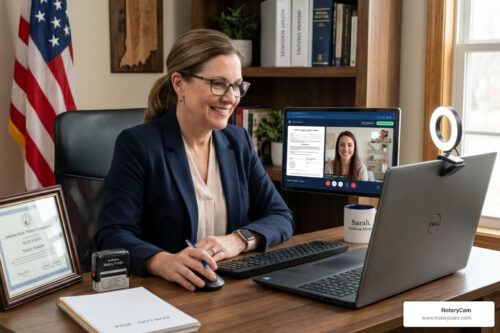
Once your identity is confirmed, you join a live video session with a commissioned online notary. The notary reviews your ID visually, confirms that you appear to understand what you are signing and are doing so willingly, and witnesses your electronic signature in real time. To participate, you will need a laptop or desktop computer with a working webcam and microphone, plus a stable internet connection.
Sign and Receive Your Notarized Document
You sign the document electronically during the session. The notary then applies their digital seal and signature to complete the notarization. The session is recorded and stored in accordance with applicable state law, and you will generally receive a digitally sealed copy of your notarized document shortly after the session ends.
Note: RON laws vary significantly from state to state. Some states have enacted comprehensive frameworks supporting online notarization for a wide range of documents, while others may restrict which document types are eligible or may not yet permit RON at all. Before scheduling a session, verify that RON is authorized in your state for your specific document and that the receiving party will accept a remotely notarized version. Your state’s notary regulating authority or an attorney can help confirm current requirements.
Benefits of Using an Online Notary
Schedule Flexibility
Many RON platforms offer session availability outside of standard business hours, which can be a meaningful advantage for people who cannot easily step away during the workday. Rather than coordinating your schedule around a notary office’s hours, you can often book a session at a time that fits your own.
No Travel Required
Online notarization removes the need to travel to a physical location. For individuals dealing with mobility challenges, living in areas with limited notary access, or simply managing a packed schedule, eliminating that trip can make an important errand considerably more manageable.
Security and Audit Trail
Many reputable RON platforms use multi-layered identity verification, encrypted video sessions, and tamper-evident digital seals. The session recording creates an audit trail that documents the entire notarization, which can be useful if questions arise about a document’s authenticity later. These features can make online notarization a well-documented option for sensitive or high-value documents.
Accessible for US Signers Abroad
If you are a US citizen traveling or living outside the country and need a document notarized, many RON platforms can accommodate that. Whether the resulting notarization will be accepted by the receiving institution depends on the specific document and the party involved, so confirming acceptance before scheduling a session is worth the extra step.
What Documents Can Be Notarized Online?
Many common personal and business documents may be eligible for online notarization, depending on state law and the requirements of the institution receiving the document. Documents that are often candidates for RON include:
- Powers of attorney, including general and healthcare POAs
- Affidavits and sworn statements
- Real estate documents such as deeds and mortgage paperwork
- Loan agreements and financial documents
- Business contracts and vendor agreements
- Certain estate planning documents
Whether a specific document qualifies for RON depends on your state’s rules and, in some cases, the particular requirements of the party requesting the notarization. Some documents, such as wills, may have additional restrictions that vary by state. If you are uncertain whether your document is eligible, checking with the requesting party or consulting an attorney before scheduling is the most reliable way to confirm.
Online Notarization vs. Traditional Options
RON is not the right fit for every situation, and understanding how it compares to other available options can help you make a practical choice for your circumstances.
Banks and Credit Unions
Many banks and credit unions offer notary services to account holders, often at no charge or a minimal fee. This can be a straightforward option for simple documents if a notary is available at your branch during the hours you need. Availability varies by location, and some banks limit notary services to customers with specific account types.
Shipping and Print Centers
UPS Store locations and similar centers frequently offer walk-in notary services for a modest fee, typically during store hours without a scheduled appointment. They can be a convenient choice for quick, simple notarizations, though availability and fees vary by location.
Mobile Notaries
A mobile notary travels to your location rather than requiring you to come to them. This can be practical for multi-signer documents, situations where someone cannot leave their home or a care facility, or transactions that need to happen at a specific address. Mobile notaries typically charge a notarization fee plus a travel fee, making this a higher-cost option in most cases.
Remote Online Notarization (RON)
RON often offers the most flexibility in terms of both location and scheduling, since sessions can often be completed at any time of day and from any location with a reliable internet connection. For individuals and small businesses that need notarizations on their own schedule, across different locations, or outside of standard business hours, it is often the most convenient option, provided the document type and applicable state law support it.
| Option | Travel Required | Hours | Speed | Availability |
|---|---|---|---|---|
| Online Notary | No | Extended | Fast | Nationwide |
| Bank Notary | Yes | Business hours | Moderate | Limited |
| UPS Notary | Yes | Store hours | Moderate | Varies |
| Mobile Notary | No | Appointment-based | Slower | Local |
How to Find a Reliable Online Notary Service
Not all online notary platforms are equivalent. A few things are worth checking before committing to a service.
Confirm State Authorization
The most important starting point is verifying that RON is legally permitted in your state for the document you need notarized. Your state’s Secretary of State website or notary regulating authority is the most reliable place to find accurate, current information on approved platforms and eligible document types.
Look for Vetted, Commissioned Notaries
A reputable platform will work with notaries who are state-commissioned and properly authorized to perform RON. Established services typically vet their notaries and can provide information about notary credentials if you ask.
Review Security and Record-Keeping Practices
Look for platforms that use multi-step identity verification, encrypted video sessions, tamper-evident document seals, and session recording with clearly stated retention periods. These features indicate a platform built to meet professional and legal standards.
Read Reviews from Verified Users
User reviews from verified customers can offer practical insight into how a platform performs in real sessions. Platforms with a consistent track record across a high volume of notarizations tend to be more reliable than newer or less-established options.
NotaryCam is one platform that serves both individual and business clients across a range of document types and industries. For consumers looking for a one-time notarization, the Notarize Now option can connect you with a commissioned notary quickly. For small businesses with recurring notarization needs, exploring NotaryCam’s business service options may be a practical next step.
Frequently Asked Questions
Is an online notary near me legally valid?
In most U.S. states, yes. Many U.S. states have enacted laws authorizing Remote Online Notarization (RON), and documents notarized through a compliant RON platform can carry the same legal weight as those completed in person. That said, RON laws, approved platforms, and eligible document types vary significantly by state. Some states have not yet enacted comprehensive RON frameworks. Before relying on an online notarization for an important transaction, confirm that RON is permitted in your state for your specific document type and that the receiving institution will accept it. Consulting an attorney is the safest option if you are uncertain.
What do I need to complete an online notarization?
You will typically need a laptop or desktop computer with a working webcam and microphone, plus a stable internet connection. You will also need a valid government-issued photo ID, such as a driver’s license or passport, ready to present to the camera during the session. Your document should be complete but unsigned before the session begins. Some platforms may have specific browser or device requirements, so reviewing those details in advance can prevent last-minute delays. Being in a quiet, well-lit space during the session also tends to help things run smoothly.
What types of documents can be notarized online?
Many common documents may be eligible for online notarization, including powers of attorney, affidavits, certain real estate documents, loan agreements, and business contracts. Whether a specific document qualifies depends on your state’s law and the requirements of the party requesting or receiving the notarization. Some document types, such as wills, may have additional restrictions that vary by state. Confirming eligibility with the requesting party or an attorney before scheduling can save time and avoid the need to redo the process.
How does the cost of online notarization compare to traditional options?
Online notarization fees vary by platform and document type. In many cases, the cost is comparable to or lower than traditional in-person options, particularly when you factor in the time saved by not traveling. Traditional notary fees are regulated by most states and typically range from a small per-signature fee to higher amounts depending on location and service type. Mobile notary services tend to cost more due to added travel fees. For a straightforward notarization, RON can be a competitive and convenient option. Reviewing the pricing page of any platform you are considering will give you the most accurate current information.
Can a small business use online notarization regularly?
Yes, in many cases. Small businesses that routinely need notarized documents, such as affidavits, contracts, loan paperwork, or compliance filings, may find RON a more efficient approach than scheduling individual in-person appointments each time. The key considerations are whether RON is permitted in your state for the relevant document types and whether receiving parties will accept remotely notarized documents. For businesses with remote staff, multiple locations, or clients in different states, RON can be especially practical. Platforms like NotaryCam offer options suited to both individual sessions and ongoing business notarization needs.
Conclusion
Searching for an online notary near me is a natural starting point, but in practice, location is rarely the most important factor. Remote Online Notarization can connect you with a commissioned notary from wherever you are, on a schedule that works for you, without requiring an in-person appointment. For individuals managing busy lives and for small businesses with recurring notarization needs, that flexibility can make a real difference.
The steps that matter most before getting started are confirming that RON is authorized in your state for your specific document, making sure your equipment meets the platform’s technical requirements, and verifying that the party receiving your document will accept a remotely notarized version. With those details confirmed, platforms like NotaryCam can guide you through the process from document upload to digitally sealed delivery.
Online notarization continues to gain acceptance across industries and jurisdictions, and the process is generally more straightforward than many people expect. If you have a document that needs notarizing and want a flexible option, it may be worth exploring whether RON is available and appropriate for your situation.


 Your Privacy Choices