



Disclaimer: This blog post is for informational purposes only and does not constitute legal advice. Please consult an attorney for guidance on specific laws regarding Remote Online Notarization (RON), digital signatures, and related legal matters. As laws concerning RON and notarization are subject to frequent changes, it is advisable to verify current regulations with your local government.
When you are finalizing a vehicle sale at a dealership, or helping a customer wrap up a private transaction, a bill of sale often raises a common question: does it need to be notarized?
The short answer is that it depends on the state. The longer answer is that even when notarization is not strictly required, it can still be a smart step worth recommending to customers and building into your dealership’s process.
| Quick AnswerA bill of sale is a document that records the transfer of ownership of property, commonly used for vehicle transactions. Whether a bill of sale must be notarized depends on the laws of the state where the transaction occurs and the specific requirements of the DMV. In many states notarization is optional, but some jurisdictions require it for certain vehicle sales or title transfers. |
Does a Bill of Sale Have to Be Notarized? It Depends on Where You Are
Notarization requirements for bills of sale vary significantly from state to state, and vehicle transactions add another layer of complexity. Some states, including West Virginia, Montana, North Carolina, Louisiana, and Maryland, have notarization requirements associated with certain vehicle transactions. In some cases the notarization applies to the vehicle title itself, while in others a bill of sale may need to be notarized. Because the rules differ by state and transaction type, confirming requirements with the appropriate DMV is essential.
Requirements can also change over time, and DMVs may have their own documentation policies, which is why verifying current rules with the appropriate agency is important before completing a transaction.
For dealerships operating across state lines or handling out-of-state buyers, those differences can create real friction. A deal that moves smoothly in one state may run into DMV complications in another. Building a reliable verification step into your workflow, including confirming local requirements before finalizing paperwork, can help reduce those delays.
Note: Notarization laws vary significantly from state to state. Some states have comprehensive frameworks requiring notarized bills of sale for vehicle transactions, while others may have no such requirement or apply rules selectively based on whether a transaction is private or dealer-facilitated. Before finalizing any transaction, check with your state’s DMV or Secretary of State and consult with an attorney familiar with vehicle title and notarization laws in your jurisdiction.
Why Notarization Can Still Make Sense Even When It Is Not Required
Even in states where a notarized bill of sale is technically optional, there are good reasons to recommend it. For dealerships, a notarized document may help reduce post-sale disputes by creating a clear, third-party-verified record of the agreed-upon terms, the sale price, vehicle condition, and the identities of the parties involved.
From a risk management perspective, fraud prevention experts generally recommend adding verification layers to high-value transactions. A notary’s role, confirming identities and witnessing signatures, can help deter fraudulent activity and may help strengthen the document’s credibility if a dispute ever reaches a legal proceeding.
For your customers, walking away with a notarized bill of sale may also provide peace of mind. Many buyers, particularly those making a significant purchase, appreciate having documentation that has been formally witnessed and verified.
How Remote Online Notarization Can Work for Auto Transactions
Traditional notarization generally requires the signer to appear in person before a commissioned notary, which can slow things down, especially for out-of-state buyers or customers who have time constraints. Remote Online Notarization (RON) offers an alternative that many dealerships are beginning to explore.
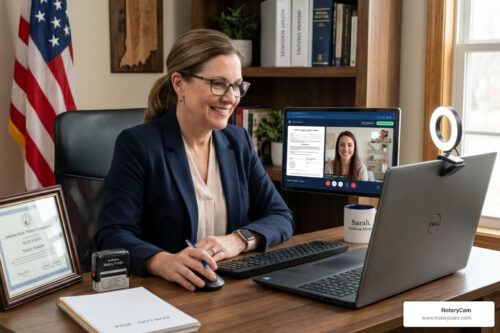
With RON, the notarization process takes place over a secure audio-video session. The notary verifies participant identities, witnesses the signing electronically, and completes the notarization using a digital seal or certificate. Participants need a device with a webcam and audio capabilities, along with a stable internet connection.
Platforms like NotaryCam specialize in RON services and support dealerships looking to modernize their document workflows. That said, RON is not universally accepted for vehicle transactions. Some states permit it for bills of sale but restrict it for title transfers, while others may not recognize it at all for automotive paperwork. Confirming with your state’s DMV before offering RON to customers is an important step.
Frequently Asked Questions
Does a bill of sale have to be notarized for a car sale?
It depends on the state. Some states require notarization as part of the vehicle registration or title transfer process, while others treat it as optional. For dealerships, the safest approach is to confirm requirements with your local DMV before finalizing transactions, particularly when out-of-state buyers or cross-border deals are involved. Consulting an attorney familiar with your jurisdiction’s vehicle title laws can also help clarify your obligations.
Can dealerships use Remote Online Notarization for bills of sale?
Many dealerships are exploring RON as a way to streamline transactions, particularly for customers who are purchasing remotely or out of state. RON may be a valid option depending on your state’s laws, but not all DMVs accept electronically notarized vehicle documents. Before implementing RON into your dealership workflow, verify that your state permits it for the specific document types involved and that your DMV will accept the output.
What does a notary actually do during a bill of sale signing?
A notary public serves as an impartial witness to the signing. Their primary roles are confirming the identities of the parties involved using acceptable government-issued identification and verifying the identities of the parties involved using acceptable identification and confirming that the signing appears voluntary. The notary then applies their signature, seal, or stamp to complete the process. It is worth noting that a notary cannot provide legal advice or instruct signers on how to fill out forms.
What happens if a bill of sale is not notarized when it should be?
In states where notarization is required for vehicle transactions, skipping it could potentially delay or complicate the title transfer and registration process. In some cases, the DMV may reject the paperwork or require additional documentation. For dealerships, that can translate into delayed deliveries and unhappy customers. In some cases, notarizing the bill of sale may help reduce uncertainty about the transaction, even if it is not explicitly required.
Are there states where notarization is commonly required for vehicle bills of sale?
Yes. States such as West Virginia, Montana, North Carolina, Louisiana, and Maryland have specific notarization requirements related to vehicle transactions, though the details vary. Some require notarization on the title, some on the bill of sale, and some on both. Because requirements change and can differ based on the type of sale (private vs. dealer), checking directly with your state’s DMV or a qualified attorney is strongly recommended before drawing any conclusions about your specific situation.
Conclusion
Whether a bill of sale has to be notarized often comes down to where the transaction is happening and what type of sale is involved. For dealerships, the variation across states can create complexity, particularly when handling out-of-state buyers or fleet transactions that cross jurisdictional lines.
Even when notarization is not legally required, it can offer practical advantages: clearer documentation, reduced dispute risk, and a more professional experience for your customers. Building a consistent notarization step into your process, or at least knowing when to recommend it, can be a worthwhile investment.
As RON continues to expand into automotive transactions, dealerships may find it a useful option for streamlining remote deals. Just be sure to verify your state’s current rules and confirm DMV acceptance before rolling it out. When specific legal questions come up, consulting an attorney familiar with your state’s vehicle title and notarization requirements remains the most reliable path forward.



 Your Privacy Choices