



How Indiana Remote Notary Platforms Are Changing Document Execution
Disclaimer: This blog post is for informational purposes only and does not constitute legal advice. Please consult an attorney for guidance on specific laws regarding Remote Online Notarization (RON), digital signatures, and related legal matters. As laws concerning RON and notarization are subject to frequent changes, it is advisable to verify current regulations with your local government.
An Indiana remote notary platform is a state-approved vendor platform that allows Indiana-commissioned notaries to perform remote notarizations in accordance with Indiana requirements over a secure, two-way audio-visual connection, without the signer and notary being in the same room.
Here is a quick summary of what you need to know:
- Indiana authorized Remote Online Notarization (RON) on July 1, 2019, under Senate Bill 372.
- Notaries must hold an existing Indiana commission and complete a state-required training course before performing RON.
- Signers can often be located outside Indiana, and in some cases outside the United States, provided Indiana’s location and use requirements are satisfied, while the notary must be physically in Indiana during the session.
- Both parties need a device with a working webcam and microphone, plus a reliable internet connection.
- Approved vendor platforms must support Indiana’s requirements for identity verification, audiovisual communication, and session recording retention.
For enterprise teams managing high volumes of mortgages, powers of attorney, or commercial contracts, these platforms can reduce common workflow friction points such as long timelines, scheduling bottlenecks, and manual handoffs. For Indiana notaries looking to expand their practice, these platforms can also open up new client opportunities and allow you to serve signers across the state and beyond.
Indiana has one of the more clearly defined RON frameworks in the country. The rules are specific about who can perform remote notarizations, which platforms are authorized, and how signers must be verified. That clarity can be useful whether you are a notary building a remote practice or an organization looking for a more predictable and auditable process at scale.
Note: RON laws vary significantly from state to state. Some states have comprehensive frameworks supporting RON, while others may have restrictions or different requirements. Before implementing any solution, check with your state’s regulatory authorities and consult with an attorney familiar with notary laws in your jurisdiction to ensure compliance with current local legislation.
The Legal Framework for an Indiana Remote Notary Platform
The transition to digital notarization in the Hoosier state did not happen overnight. It was a deliberate legislative process that culminated in Senate Bill 372, which was signed into law on March 13, 2018. This bill set the stage for the permanent authorization of remote notarization effective July 1, 2019. To ensure the process remained secure and standardized, the Indiana Secretary of State adopted final rules known as 75 IAC 7.
These regulations are designed to protect all parties involved in a transaction. They mandate that any Indiana remote notary platform used must be capable of recording the entire session and storing it for at least ten years. Furthermore, the technology must support a high-quality, two-way audio-visual feed. This means both the notary and the signer must use a device with webcam and audio capabilities and a reliable internet connection to ensure the session is clear and uninterrupted.
The legal framework also clarifies that while the notary must be physically located within the borders of Indiana, the signer does not have to be. This opens up significant opportunities for international business and for Indiana residents traveling abroad who need to execute legal documents. Indiana’s framework is designed to support enforceable remote notarization procedures when its requirements are followed, though acceptance may still depend on the receiving party and applicable jurisdiction.
Note: Notarization laws vary significantly from state to state. Some states have comprehensive frameworks supporting RON, while others may have restrictions or different requirements. Before implementing any solution, check with your state’s regulatory authorities and consult with an attorney familiar with notary laws in your jurisdiction to ensure compliance with current local legislation.
Steps to Become an Authorized Remote Notary in Indiana
Becoming a remote notary in Indiana is a multi-step process that builds on a traditional commission. First, you must already hold an active traditional notary public commission in the state. If you are just starting out, you can review the process in the Indiana Notary Public Guide.
It is important to note that a traditional commission in Indiana typically lasts for an 8-year term, and applicants generally need at least 90 days remaining on that commission to apply for remote authorization.
Once your traditional commission is in order, you can visit the Secretary of State Website to begin the remote application. This includes completing a state-approved remote notary education course, which typically takes about three hours. After the course, you must pass an exam with a score of 80% or higher.
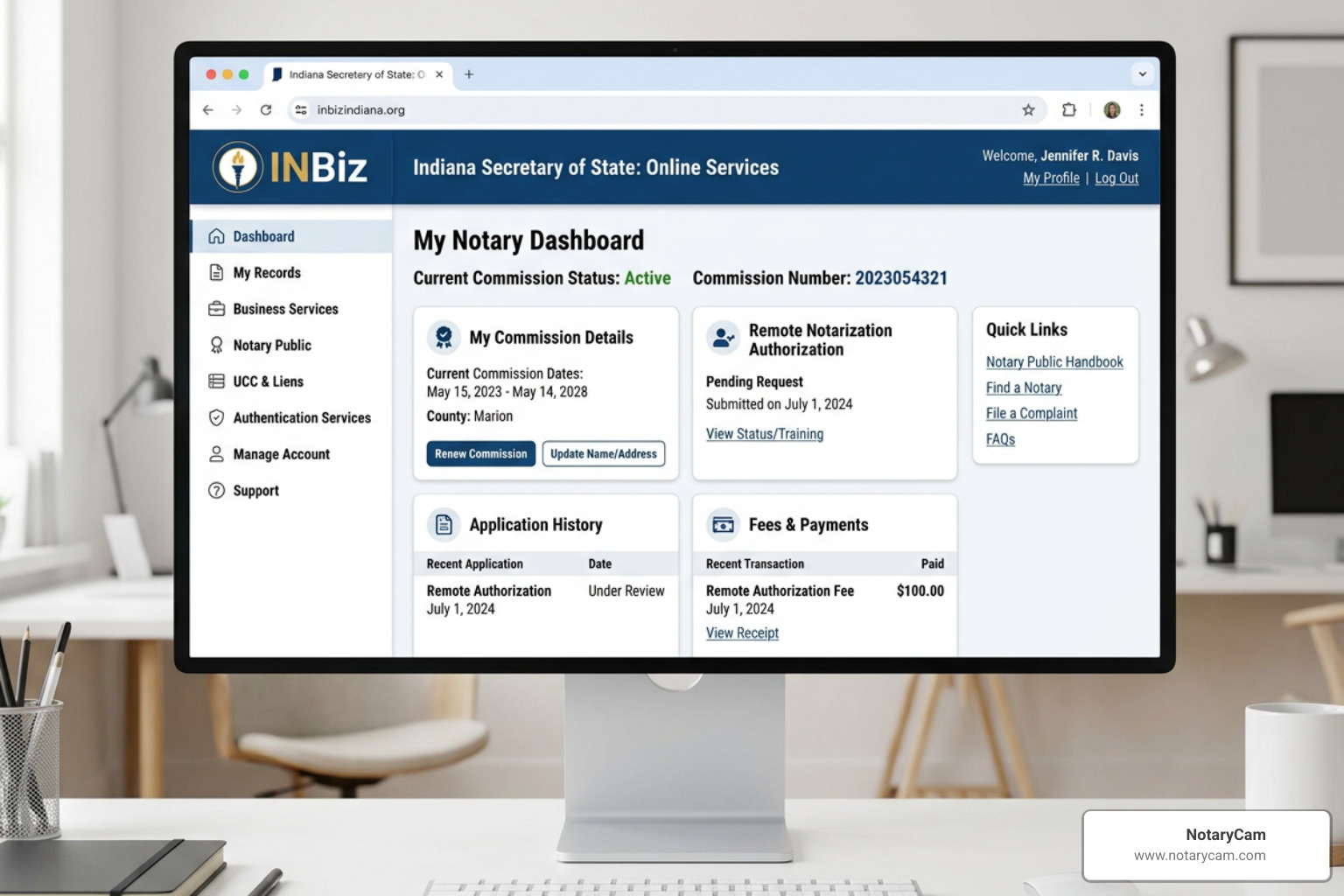
After passing the exam, you can submit your application through the INBiz portal and pay a nonrefundable fee. During this process, you will need to name the state-approved technology provider you plan to use.
What Indiana Remote Notaries Should Look for in a Platform
Once you have your Indiana remote notary authorization in hand, choosing the right platform is one of the most consequential decisions you will make for your practice. The platform you select determines how you schedule sessions, how identity verification is handled, how your journal and session recordings are stored, and ultimately how professional the experience feels for your clients.
The first thing to evaluate is whether the platform meets Indiana’s specific technical and record-keeping requirements. Indiana rules require session recordings to be stored for a minimum of ten years. Confirm that any platform you consider documents this retention period explicitly and that storage is handled securely rather than left to you to manage independently.
Pricing structure matters significantly for independent notaries. Some platforms charge flat monthly fees regardless of how many sessions you complete, which can be difficult to manage when volume fluctuates. Look for a model that includes no minimum monthly usage requirements so slower months do not carry unnecessary overhead. NotaryCam’s independent notary software, for example, offers a monthly licensing fee with per-transaction pricing and no minimum monthly usage, which can give solo practitioners more flexibility as they build their client base.
Journal and session management tools are worth examining closely. A platform with built-in document tagging, session scheduling, and electronic journal management can reduce the administrative side of running a remote notary practice considerably. These features allow you to focus on the notarization itself rather than manually tracking records across separate systems.
Finally, consider what support and training resources come with the platform. As a newly authorized remote notary, the learning curve for the technology can be steeper than the authorization process itself. Platforms that provide training materials, a testing environment, and accessible customer support can make that transition meaningfully smoother.
Note: Platform requirements and state authorization rules can change. Always verify current Indiana Secretary of State requirements and confirm that your chosen platform meets state-approved technology standards before completing your first remote session.
Technical Requirements for an Indiana Remote Notary Platform
The technical standards for remote notarization are higher than those for a standard video call. An approved Indiana remote notary platform must provide a secure, encrypted environment for the signing. It must also support two-way audio-visual communication, so participants need a device with webcam and audio capabilities and a reliable internet connection.
One of the key features is credential analysis, which uses a third-party vendor to authenticate the signer’s government-issued ID. Another common layer is Knowledge-Based Authentication (KBA), which asks the signer questions generated from public-record data. These steps help reduce the risk of fraud or altered identification being used in the session.
Hardware needs are fairly simple but important. A high-definition webcam can help the notary view the signer and identification more clearly. A working microphone, speakers, and a quiet, well-lit environment also support a clearer recording of the verbal acknowledgments.
Eligible Documents for an Indiana Remote Notary Platform
Many documents that can be notarized in person may also be handled through a remote platform. Common examples include powers of attorney, affidavits, and real estate documents such as deeds or mortgages.
There are still practical limits to keep in mind. Documents related to birth, death, or marriage certificates are generally not eligible, and receiving parties may have their own acceptance standards.
For real estate transactions, RON is often used to support closings where parties sign from different locations. This approach can shorten turnaround times and reduce dependence on shipping physical documents. Industry observers note that RON adoption has helped streamline workflows for some title companies and lenders.
Security Protocols and Identity Verification
Security is a core design consideration for any Indiana remote notary platform. To replace the physical presence of a signer, the state requires a robust multi-factor authentication process. This starts with Credential Analysis, where the signer’s ID is scanned and verified by a third-party vendor. This is often followed by Knowledge-Based Authentication (KBA), where the signer must correctly answer questions about their past that only they would likely know.
Indiana’s framework generally relies on layered identity verification, including ID review, credential analysis, and identity proofing. This level of security often involves a combination of remote ID presentation and live video check to match the person on the screen to the ID provided. Once the identity is confirmed, the notary can proceed with the signing. The final document is then secured with tamper-evident technology, which means any attempt to alter the document after signing may be detectable through the tamper-evident seal.
The use of a secure digital seal is another important security feature. Unlike a physical rubber stamp, a digital seal is an electronic image that is cryptographically linked to the notary’s digital certificate. This certificate verifies the notary’s identity and ensures the document’s integrity. To facilitate this secure exchange, both the notary and the signer need a device with webcam and audio capabilities and a reliable internet connection.
Note: Notarization laws vary significantly from state to state. Some states have comprehensive frameworks supporting RON, while others may have restrictions or different requirements. Before implementing any solution, check with your state’s regulatory authorities and consult with an attorney familiar with notary laws in your jurisdiction to ensure compliance with current local legislation.
Frequently Asked Questions
Is remote online notarization legal in Indiana?
Yes, remote online notarization is authorized in Indiana and has been in effect since July 1, 2019. The state framework includes Senate Bill 372 and related administrative rules in 75 IAC 7. Notaries generally need a traditional Indiana commission before applying for remote authorization, and participants need a device with webcam and audio capabilities and a reliable internet connection.
Note: RON laws vary significantly from state to state. Some states have comprehensive frameworks supporting RON, while others may have restrictions or different requirements. Before implementing any solution, check with your state’s regulatory authorities and consult with an attorney familiar with notary laws in your jurisdiction to ensure compliance with current local legislation.
What identity verification is required for RON in Indiana?
Indiana generally uses a multi-step identity verification process for RON. This often includes presenting a government-issued photo ID which is analyzed by a third-party vendor (also known as credential analysis), and knowledge-based authentication questions. The photo ID used for credential analysis must also be presented during the notary session. The session also requires a laptop, computer or tablet with webcam and audio capabilities and a reliable internet connection so the notary can review the signer and the identification in real time.
Can a signer be outside of Indiana during the notarization?
In many cases, yes. The signer may be located outside Indiana, and sometimes outside the United States, as long as the notary is physically located in Indiana at the time of the act and other legal requirements are satisfied. If the signer is abroad, there may be additional limits tied to U.S. courts, U.S. property, or the intended use of the document.
What technology is needed to use an Indiana remote notary platform?
Most people can use a computer, laptop or tablet with a working webcam and microphone. A stable internet connection is also necessary to support the required two-way audio-visual communication throughout the session. Many platforms also ask for a valid email address so the signer can receive access links and the completed electronic document.
How do I choose a platform as an Indiana remote notary, and can I use NotaryCam with my existing commission?
Once you hold an active Indiana remote notary authorization, you can typically use any state-approved platform that meets Indiana’s technical requirements under 75 IAC 7, including session recording, identity verification, and secure journal storage. When evaluating platforms, it is worth looking at pricing structure, whether the platform requires minimum monthly usage, what training and support resources are available, and how the platform handles the 10-year session recording retention Indiana requires.
NotaryCam offers a software licensing option for independent notaries that is compatible with an existing Indiana remote notary commission. To get started, you would need to provide your RON certification, a current digital certificate, a valid notary seal, a background check, and proof of E&O insurance. The platform includes credential analysis links, session scheduling, electronic journal management, and 10-year minimum video and journal retention, with no minimum monthly usage requirements.
As with any platform decision, confirm that your chosen provider meets current Indiana Secretary of State standards before completing your first session, and consult with a legal professional if you have questions about compliance with Indiana’s specific RON requirements.
Conclusion
Indiana has established a solid framework for digital document execution that balances convenience with strong security requirements. By following the state’s education, authorization, and bonding rules, notaries can expand the ways they serve clients. Signers may benefit from handling important documents from home, the office, or while traveling, provided they have a laptop or tablet with webcam and audio capabilities and a reliable internet connection.
For businesses, this can support faster document turnaround and more flexible scheduling. For individual signers, it can reduce the need for travel and in-person appointments. Those practical benefits are part of why remote notarization continues to gain adoption across legal and business workflows.
For Indiana notaries considering the move to remote practice, choosing the right platform is one of the most consequential early decisions. A platform that handles session recording, journal management, and identity verification within a single workflow can reduce administrative overhead and let you focus on serving clients well.
It is still important to stay current with Indiana Secretary of State guidance and with any acceptance requirements from the receiving party. If you are comparing providers, platforms such as NotaryCam may be worth exploring as one option for remote online notarization and related digital execution tools.
Note: RON laws vary significantly from state to state. Some states have comprehensive frameworks supporting RON, while others may have restrictions or different requirements. Before implementing any solution, check with your state’s regulatory authorities and consult with an attorney familiar with notary laws in your jurisdiction to ensure compliance with current local legislation.
You can learn more here: More info about remote online notarization




 Your Privacy Choices